
NOVEMBER 2007
Radon - A radio-active isotope
Radon gas comes from the radioactive decay of uranium which occurs naturally in all rocks and soils. Radon is soluble in water and thus may accumulate in water as it passes over rocks and through soil. As radon is a gas it is easily lost from water when it is agitated for example when river or lake water flows over rocks or is moved by wind. This is very like what happens when a bottle of fizzy mineral water is shaken; the bubbles released represent the loss of dissolved gas. In this way surface water (lake and river water), which currently accounts for approximately 75% of drinking water supplies in Ireland, normally shows very low levels of radon.
Ground water (from wells and bore holes) on the other hand, does not tend to be agitated before reaching the domestic tap, so if there is radon present it tends to remain in the water. When the domestic tap is turned on some of the radon will be released into the air due to the agitation of the water as it is dispensed from the tap, but some will remain dissolved in the water and may be consumed.
Health implications of radon in drinking water
Ingestion of dissolved radon will result in a radiation
dose to the lining of the stomach. However, a definitive
link between consumption of radon-bearing water and
cancer has not been established. Inhalation of radon gas
that has been released from tap water will contribute to
the radon content of indoor air and, if inhaled, will
result in a radiation dose to the lung. Long-term
exposure to high concentrations of radon
in indoor air increases the risk of lung cancer.
Globally, the radiation dose from radon in drinking water is low compared with that from the inhalation of radon gas. However it is prudent to regard both of these sources of radon with similar concern and reasonable measures should be taken to minimise exposure to radon in drinking water. For this reason the Institute advises that domestic water supplies of groundwater or partial groundwater origin should be tested for radon, and if the recommended standards are exceeded the supply should be remediated.
It should be noted that while the Institute estimates that approximately 91,000 houses or 7% of the national housing stock have levels of radon in air that exceed the National Reference Level, less than 3% of the groundwater supplies tested to date contain radon levels that exceed the recommended standards.
Recommended Standards
Guidance on levels of radon and its decay products in
drinking water is covered in EC Recommendation
(2001/928/Euratom) on the protection of the public
against exposure to radon in drinking water supplies. The
Recommendation proposes 1000 becquerels per litre (Bq/l)
as an action level for both public and private water
supplies and can be summarised as follows:
For public water supplies, if the radon concentration exceeds 1000 Bq/l, remediation is considered justified. Where the radon level is above 100 Bq/l but below 1000 Bq/l, the local authority must consider whether this poses a risk to human health. If it is concluded that such a risk exists, then remedial action should be considered.
For private water supplies, where water is found to have levels of radon in excess of 1000 Bq/l remediation of the supply should be considered.
The Institute advises that where the radon level in public water supplies is above 500 Bq/l remediation is considered justified for the protection of human health
The definition of “public water supplies” includes:
- drinking water supplied as part of a public or
commercial activity (including private water
supplies to public facilities, such as schools
and hospitals)
- group water schemes
What areas of Ireland are at risk?
There is no direct relationship between the amount of
uranium in the underlying rocks and soil and the
concentration of radon in the water supply, nor has any
direct relationship been established between radon in
indoor air and radon in water. Therefore it is not
possible to predict if any areas of Ireland are more at
risk than others. For this reason the Institute
recommends that all domestic water supplies of
groundwater or partial groundwater origin are tested for
radon.
Information
on radon testing
To have your water tested for radon download an application form.
The application form should be printed out, completed and
returned to the Institute with the appropriate payment.
Alternatively, phone the Institute’s FREEPHONE RADON
1800 300 600. The Institute charge for radon analysis is
€62 per water sample.
Remediation of water
supplies
In many cases domestic water will be boiled before being
consumed. Boiling effectively removes almost all of the
radon dissolved in the water. However, the radon released
during boiling will enter the air of the house and the
occupants will then be exposed to the risk of inhaling
radon gas. For this reason boiling of water should be
carried out in a well-ventilated space, and for practical
reasons, it is not recommended as a long-term remediation
strategy.
Because radon is a gas that is readily lost from water
over time or due to agitation of the water, the
installation of a holding tank, an aeration unit or an
agitation system, between the source and the domestic tap
will significantly reduce the level of radon in the tap
water. Proven radon in drinking water remediation
products are available and information on radon
remediation in Ireland can be obtained by contacting the
Institute on envirolab@rpii.ie
or by phoning the Institute’s radon freephone
1-800-300-600.
Irish readers google http://www.rpii.ie/images/maps/iremap.jpg
if instructions do not work
Technical Note: Version 4.0 (or higher) of Microsoft Internet Explorer is required to view the radon maps
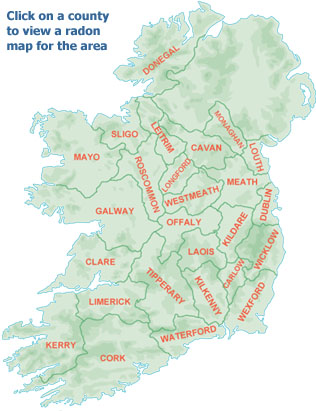 |
 |
Leinster Carlow Dublin Kildare Kilkenny Laois Louth Longford Meath Offaly Westmeath Wexford Wicklow |
Connaught Galway Leitrim Mayo Roscommon Sligo
|
Radon is a naturally occurring radioactive gas which originates from the decay of uranium in rocks and soils. It is colourless, odourless and tasteless and can only be measured using special equipment. When radon surfaces in the open air, it is quickly diluted to harmless concentrations, but when it enters an enclosed space, such as a house or other building, it can sometimes accumulate to unacceptably high concentrations.
Radon decays to form tiny radioactive particles, some of which remain suspended in the air. When inhaled into the lungs these particles give a radiation dose which may damage cells in the lung and eventually lead to lung cancer.
Radon concentration is measured in becquerels per cubic metre of air (Bq/m3). The becquerel is a unit of radioactivity and corresponds to one radioactive disintegration per second.
The Reference Level for long-term exposure to radon in a house, above which the need for remedial action should be considered, is 200 Bq/m3 (determined in accordance with RPII's standard protocol). Based on current knowledge it is estimated that in Ireland, for the population as a whole, a lifetime exposure (ie 70 yrs) to radon in the home at the Reference Level of 200 Bq/m3 carries a risk of about 1 in 50 of contracting fatal lung cancer. This is approximately twice the risk of death in a road accident.
Since July 1998, every new house is required to incorporate some degree of radon preventive measures at the time of construction in accordance with the revised Building Regulations. The degree of protection required is dependent upon whether or not the site is located within a High Radon Area.
Monitoring incase of International
Accidents at Nuclear Facilities for Electricity
|
|||||||||


| Mary Fegan |
Radioactivity monitoring for foodstuffs Monitoring radioactivity levels in food at the RPII Natural radioactivity has
been present in both the terrestrial and marine
environments since the formation of the earth. In
addition, inputs of artificial origin have come
from the testing of nuclear weapons in the
atmosphere, accidents such as that at Chernobyl,
as well as the routine discharges from nuclear
installations. Once present in the environment,
radionuclides are available for uptake by
seafood, vegetation, crops and animals and so
make their way into the food chain. Contact: Mary Fegan;
E-mail: mfegan@rpii.ie
|
Radiological
Protection Institute of Ireland (RPII)
3 Clonskeagh Square, Clonskeagh Road,
Dublin 14, Ireland.
Tel: +353 1 269 77 66. Fax: +353 1 269 74 37. Email:rpii@rpii.ie