
NOVEMBER 2007
Iraqi dam 'at risk of collapse'
Has this dam become on of the US weapons of war?
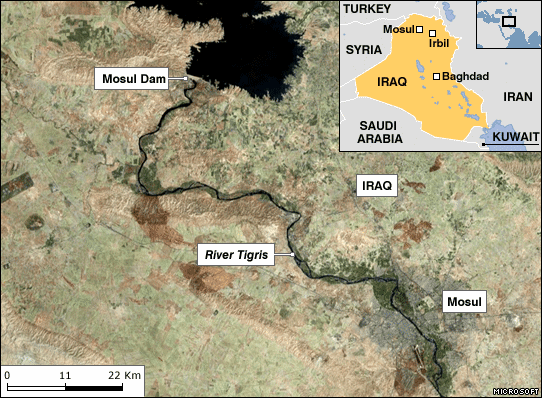
The largest dam in Iraq is at risk of an imminent collapse that could unleash a 20m (65ft) wave of water on Mosul, a city of 1.7m people, the US has warned.
In May, the US told Iraqi authorities
to make Mosul Dam a national priority, as a catastrophic
failure would result in a "significant loss of
life". However, a $27m (£13m) US-funded
reconstruction project to help shore up the dam has made
little or no progress. Iraq says it is reducing the risk
and insists there is no cause for alarm.
However, a US watchdog said reconstruction of the dam had been plagued by mismanagement and potential fraud.
In a report published on Tuesday, the Special Inspector General for Iraq Reconstruction (SIGIR) said US-funded "short-term solutions" had yet to significantly solve the dam's problems. SIGIR found multiple failures in several of the 21 contracts awarded to repair the dam. (However the BBC, as usual, do not name any of the firms on this contract stage.)
Among the faults were faulty construction and delivery of improper parts, as well as projects which were not completed despite full payments having been made. The dam has been a problem for Iraqi engineers since it was constructed in 1984. It was built on water-soluble gypsum, which caused seepage within months of its completion and led investigators to describe the site as "fundamentally flawed".
In September 2006, the US Army Corps of
Engineers determined that the dam, 45 miles upstream of
Mosul on the River Tigris, presented an unacceptable
risk. "In terms of internal erosion potential of
the foundation, Mosul Dam is the most dangerous dam in
the world," the corps warned, according to the SIGIR
report. "If a small problem [at] Mosul Dam occurs,
failure is likely."
The corps later told US commanders to move their
equipment away from the Tigris flood plain near Mosul
because of the dam's instability. The top US military
commander in Iraq, Gen David Petraeus, and US ambassador
Ryan Crocker then wrote to Iraqi Prime Minister Nouri
Maliki urging him to make fixing the dam a "national
priority". A catastrophic failure of the Mosul Dam
would result in flooding along the Tigris River all the
way to Baghdad" the letter on 3 May warned.
"Assuming a worst-case scenario, an instantaneous
failure of Mosul Dam filled to its maximum operating
level could result in a flood wave 20m deep at the city
of Mosul, which would result in a significant loss of
life and property."
If that were to happen some have predicted that as many as 500,000 people could be killed.
Alarm bells
Iraqi authorities, however, say they are taking steps to reduce the risk and they do not believe there is cause for alarm. The Iraqi Minister for Water Resources, Latif Rashid, told the BBC that a number of steps were being taken to tackle the problem, including a reduction in water levels in the reservoir and a round-the-clock operation to pump grouting into the dam's foundations.
Work would also begin next year on a longer-term plan to make the foundations safe by encasing them in a concrete curtain, he added.
The BBC's Jim Muir in Baghdad says the
debate over the dam has gone on largely behind the scenes
so as not to cause public panic or attract the interest
of insurgents.
Comment: "so as not to cause public panic or attract
the interest of insurgents." Well the BBC do a
handsome job today informing anyone who can read.JBEditor