NOVEMBER 2007
Cork Jazz Festival
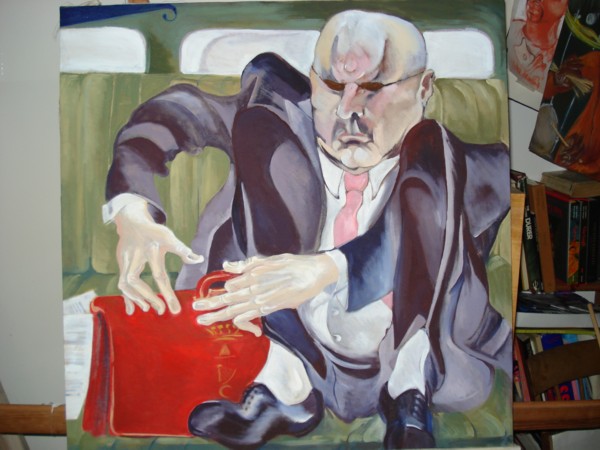
The Government Financier - oil painting by
Jocelyn Braddell
THE FIGHT TO SAVE CORK JAZZ FESTIVAL FROM DEMOLITION BY JAZZ FEATURES THAT NEVER EXISTED AS JAZZ OR MAINSTREAM BOP AND HIGH PROFIT FROM DRINK BY DIAGIO AND GRESHAM METROPOLE
Ray Comisky gave a full warning and had presumably experienced the Festival last year. Now three years under the virtual control of Diagio one wonders how many people even got through the on-line brochure after filling in their age group! What wretched fool thought that one up. I gave the dates of 103 yr.old but no reluctance was shown by anyone that I might not be able to hold up my glass-full.
Ray advised that the Everyman was your only man and
for many people that proved to be the fact - though some
said The Half-Moon Theatre had abolished its scumbag
reputation under the glorious full moon.
And on Monday it was estimated 45,000 people spent
E25,000,000, but there was no reputable Press analysis
anywhere............In the Irish Times all the minor
events EST, Avishaia Cohen, Mose Allison, Elaine Alis wer
called highlights
Where do we go from here? And what are we going to say about the present status quo to confirm that something has to be done?
No Musician's Identity Badges, No Press Photographer or Press Passes. Diagio doormen and women on other territory than their office (Where I am surprised there was not a riot as the press arrived to find only a limited "ticket selection" for them to graze on.)Photographers forbidden entry to the Everyman for the finale, the crucial The Leaders set Yes refused entry by the Manager and his staff, one a cross rude girl who put the spooks on a young Turkish photographer who railed at me "Why do they hate me?"and WORST OF ALL in the heel of the hunt,after an enthralling set, The Leaders, Bobby Watson and Chico Freeman in the final Set for this year's Festival were ignored, NO ONE from either the Cork organisers, or Diagio to thank them for giving us not only a set reminiscent of great past Festivals, putting the heart in us, but also, surely, re-introducing on Sunday night the spirit of Coltrane in a pace and mastery that comes straight from the origins of jazz - Chico Freeman and Bobby Watson, masters and hopefully leaders of a resurgence in black jazz music that must come to the population of Afro-Americans to help them survive and then overcome this vile surge of racialism that they are now experiencing in America since 9/11 - plus the loss of New Orleans, and now Harlem seriously threatened by a sell out of property to upmarket yuppies and politically correct would-be clones who wish to ban all community supports and prohibit the yearly Drumming Festival.
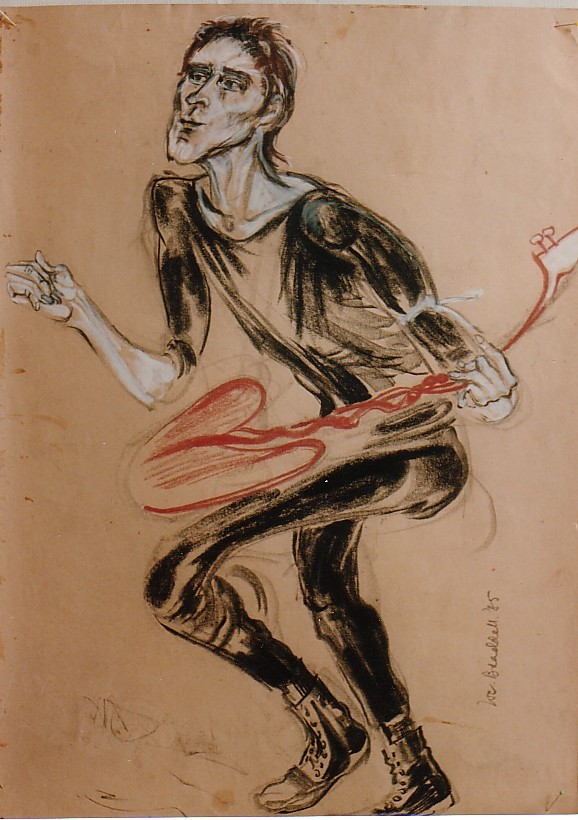
The Pleasure Cell, by Jocelyn Braddell
Conte crayon
For a start something has to be said about Jazz, the
Irish connection and the intellectual
"attraction". I don't know whether I am fit to
give this call but I will try to.
For a start we might consider the Irish emigrants arriving in the 1800s and working alongside and living alongside the Black communities in many cities. For sure the Irish brought and did not forget , but extemporized their traditional music and thus there is an open link to that and the origins of jazz.The link is the speed with which it is played. There are no langours as eventually appeared in the Tango, black cavities or killing strokes. Jazz addresses it subject head on and the powerful drum that links jazz and Tango advanced forward into an arena of beats and tracks from brushes to the extraordinary vigour of the drum solo with its many riffs, bastinados and tumultous advances. In addition the long held notes carried through by circular breathing on the Saxaphone, emphasised the previous phrase, the penultimate length of stamina, an arc of strength that could never be betrayed. The music of the merciless worker and his/her social depredation transcended
It is a fact within the tradition of
Irish music if a similar stamina and speed is dominant
those who listen get pictographic messages in the mind as
though the music itself holds genetic calibrations.
I sat once in Carrick Donegal at a late autumn festival
held there while an old man picked up his fiddle and
directed the music at an ancient woman also at the table
whose birthday he was celebrating - as he progressed the
tears flooded my eyes - but I knew not why - afterwards,
the man looking keenly round at us saw this and smiled
broadly, "Then my tune was not wasted" he said
and lifted his glass to me!
Jazz was literally introduced to many of the Irish
audiences that began over 25years ago to travel to Cork
for the October Festival at its origin, by Louis
Stewart's genius, a guitar player, and the Buckley family
Sax-men,Steve Keogh, drummer, the singer Honor Heffernan.
The Cork Jazz festival, was greeted by hundreds as a kind
of World Cup event with cars tooting on the street waving
greetings and jazz posters and ofcourse drinking and
talking full tilt in the Metropole and elsewhere. It
became rapidly, within ten years internationally
acknowledged, for the hospitality we gave to musicians
from America and elsewhere as European musicians entered
the arena. American musicians appeared in Dublin,
fantastic!And it was even regarded apart, with I think
venues in Holland for celebrated clamour, bars loaded
with glass, journalists gathered around and the fruitful
silence as jazz' first notes cut across the racket.Yes,
musicians realised that Cork was creating a tradition of
first class music. Journalists who gathered early every
Sunday morning on the Guiness quay building joined a
discussion held by the Core group of Cork entrepreneurs
to make suggestions for improvement, requests for certain
musicians etc.and a prize giving. A prize was made to a
possibly exhausted musician dragged from his bed to
receive a beautiful gift of Waterford Glass.
All this time the audiences were building up amazingly -
and here we must address the possible reason why jazz has
held the attention of so many professional people and
writers and artists, and this absolutely consistent
audience of fans travelling from all over the island and
from abroad year after year. The fact is that the
rapidity of the music already referred to, which gives
the excitement of rapidly executed turns and phrases that
must indeed be listened to with exactitude, in order to
experience a music that excites the brain and, this is
it, displays the brain as the truly wonderful instrument
of rapid thought that it is. Some may say to me - these
musicians practise every day - as if to excuse their
ability, but that is work sometimes for five long hours
or more non-stop. Also the obsession of the artist brings
demons into play as with poetry and art. What I really
want to emphasise here is also the seduction (not sexual)
of this music, that doesn't enter into the mind of the
bop/pop/or rock music fan's mind. Some drug addictions
among artists have enabled them reach this true brain
mechanism more carelessly. Possibly all dreams have to be
revealing of such mental capacity and mechanics; this
because under testing such a quantity of dream events
occur in the smallest dash of real time. If you can reach
in toward this brain activity then you can comprehend a
wider area of events in your own life and jazz fans of
the kind I am talking about experience
this elevation. A Scandanavian drummer this year said to
me - you can listen to CDs, Radio, why not! - I explained
that I personally never use any music as a background,
that I believe even music itself is generated from
silence throughout a musician's life. That he/she does
not come to music for a mere accomplishment.
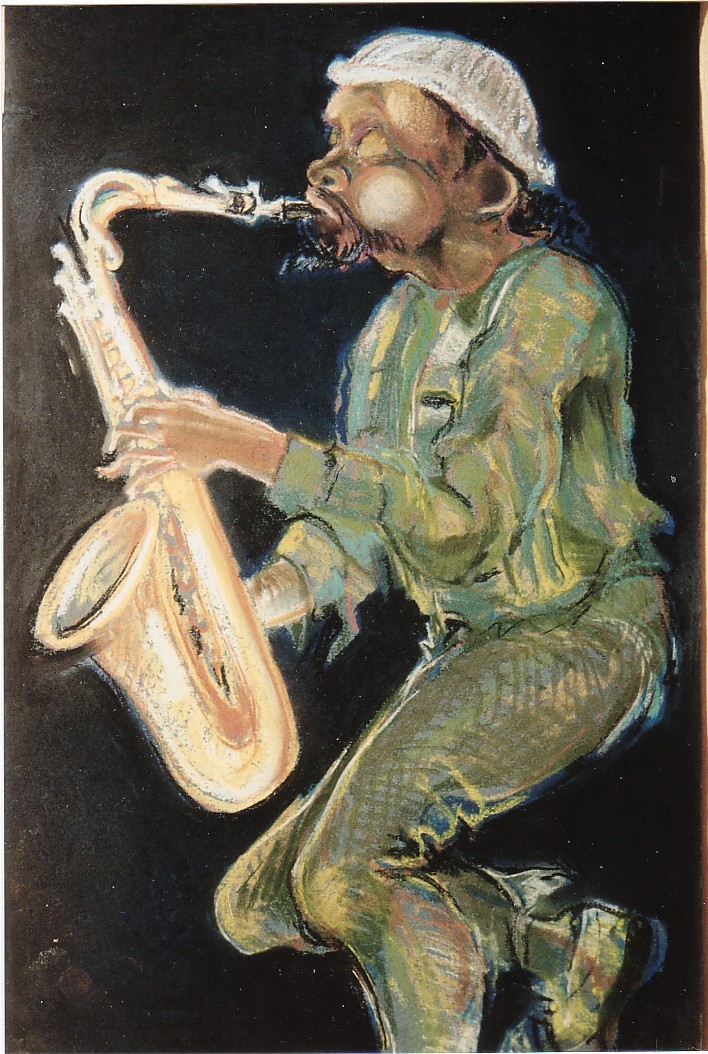
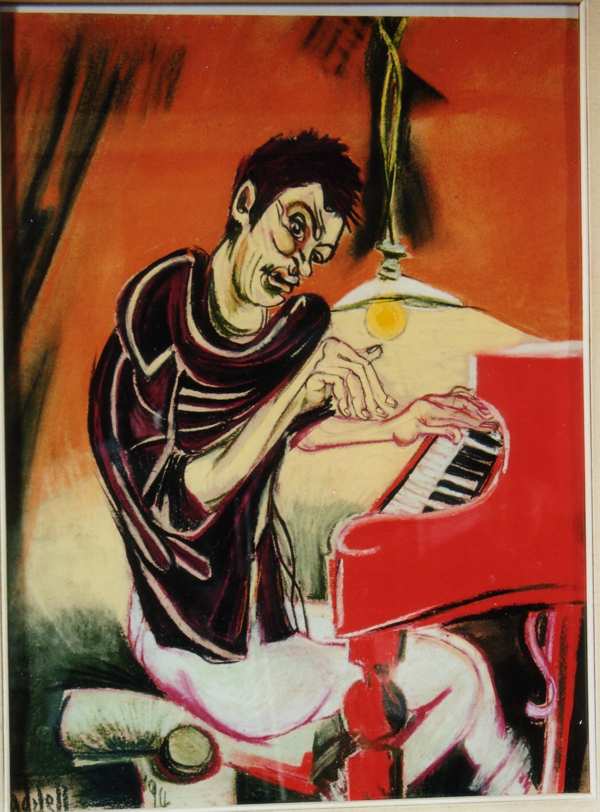
Courtney Pine at Everyman by J.Braddell,
Sennelier Oil Colours
What has happened? the Arts Council suggested to me that
the Cork group have let Diagio gain too much control -
but ofcourse the "Gresham Metropole" are now
aiding and abetting them. It was the second visit that
Courtney Pine made to Cork that suddenly brought in to
the festival hundreds of youngsters, and indeed they were
greeted aimiably as a refreshed audience - but after that
popular music began to be catered for in the Opera House.
When the Metrepole changed hands the atmosphere of care
and responsibility to the music went out the door.
Previously all bands received careful attention by
engineers controlling decibels and audiences responded to
the "Hush please" of fraught fans. The new
owners changed some of the favourite small programme
rooms where the listener was almost in a private hearing,
they opened up another, enlarged bars and behaved as
though they were protecting the premises from marauders
whose only permitted latitude was to swallow their drink.
And worst of all the all night sessions where many Irish
musicians could play with visiting professionals ended.
Disaster struck in no uncertain terms for all true jazz fans when Diagio took control. Only for the fact that Jack McGouran faithfully maintained his fantastic workload and genius finding every year so many marvellous musicians and masterclasses and bringing in young Cork musicians who have now concentrated themselves in the Cork School of Music, did many of us try it out again after last year's utter misery. The Press disbanded, even Matt Kavanagh had little and less in the Irish Times photogaphs, Brian Lynch on his trumpet yes, but Mose Allison! Dear God an anachronism! as Ray Comiskey described him, who played an utterly boring litany of songs in an utterly stifling dadadada for an hour and a half. Incidentally I was surrounded then by Americans in the photographer's haven Everyman, a box where presumably favourite Diagio guests were assembled. One being a jewish gentleman who told me he represents over 90 Radio stations on the West Coast from Canada to Mexico. Talking politically he revealed that George Bush is a fool, we have to Elect Hilary Clinton and when I admonished him that atleast Bill Clinton had handled US finances brilliantly and might sort the financial disaster that threatens, he uttered such a slur against him, and though I have a bad mouth ,I will not utter it.
Meeting Bobby Watson on Sunday morning in the Imperial he told me that a recee the night when he arrived , he had been refused entry to the Metrepole and impertinently asked for identification to prove what he said - I told him that the Press now had no Press or Photographers Passes and were only greeted with a meagre allowance of selected tickets back balcony of Opera House, Everyman etc.There is no meeting house for journalsists and musicians - and indeed where the music fans happily mixed in and greeted musicians, the Metropole Foyer, it was utterly empty or a scrum of drunken revellers.When I think what it took in the past for Metropole doormen to throw out the University Radio critic who was certainly over fond of the drink I had to laugh at what I saw and heard there.Tourist residents were not even allowed in their private rooms during the long afternoon pre-evening hiatus.
So people how about some discussions - ? - I have suggested that to the Arts Council, and will persue the idea with Diagio. There has to be acknowledgement of the still faithful and still intact 30 yr. jazz fans who have a secure place in Irish Culture, alongside the internationally recognised musicians we have here.. And acknowledgement of a musician's needs not only for his audience but for publicity and analysis and introduction to a new generation. Or else our international Festival and a historic culture will become a sad memory of the past if it is not for many absentees already this year and visible in Ray Comisky's outcry of rage just prior to this Festival in the Irish Times Listings magazine: Time was when the festival was our main source of jazz visitors and almost our sole chance to hear some of the big American names.....The Everyman hosts some trendy profile coat-tailing (he excludes and recommends Richard Galliano and Bobby Watson Chico Freeman and Eddi Henderson) and he refers to the alcohol fuelled scrum at the Metrepole.
As my machine due to some quirk of the loathed Vista mechanics it is in thrall to, has reduced me to a thin line I'll say adieu and that I hope any reading this will take actions of their own to investigate and try to save the truly significant branch of Irish Culture, that never, until disaster struck, seemed to age or reject its Afro-American and Irish emigrant core.
Jocelyn Braddell, editor.