
JANUARY2007
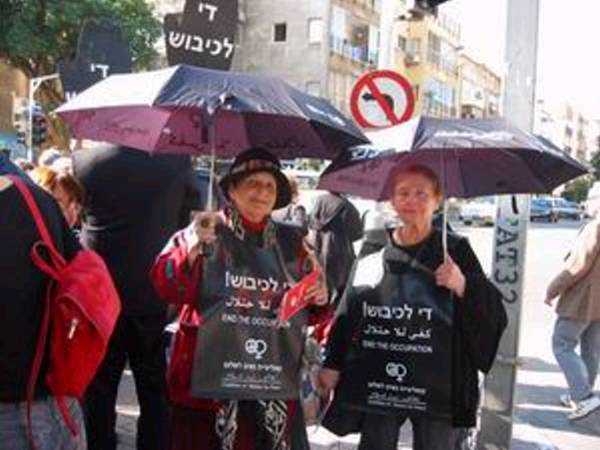
On the picket line with the Women in Black
by
Margaretta D’Arcy
Tel Aviv Nov Friday 24th
November. I have been told by an Israeli
friend that the Women in Black gather every Friday at the
corner of a particular boulevard every Friday between 1pm
and 2. This extraordinary group of women has
been standing out in public for 19 years, denouncing the
illegal occupation by Israel of lands belonging to the
Palestinians. Their presence has captured the
imagination of women world wide, and there are many
groups, in many other countries, of Women in Black.
In London women gather every week. In Galway
we have held a Women in Black solidarity action: we
were joined by some American tourists who were delighted
to find us there on the street; in the US they too were
part of A Women in Black group. Unfortunately my
computer crashed a few years ago, losing all my e-mail
contacts including The Women in Black. I knew
that they had been nominated for the Nobel Prize last
year, so it was with some trepidation that I waited at
the intersection between a busy shopping street and the
grassy Boulevard. I was a bit worried because
I was wearing bright green shoes. The rest of me
was all “in Black,” and (if they insisted) I
was quite prepared to take the shoes off and just wear my
black socks. I arrived early so I could watch the
arrive; perhaps I would be able to guess who they would
be; surely there would be some heralding, like huge
banners appearing a few minutes before the time. But
there was no-one who looked in the least likely.
I wondered, perhaps I took down the wrong address? Then
I saw an elderly woman with a black plastic bag; she
leaned it against a tree and took out some homemade cards
on sticks. Then another elderly woman joined her.
I moved closer. Yes, this was the Women in Black.
I needn’t have worried about my bright green shoes.
There was nothing at all dogmatic about their garments.
Other women joined, and a few men: about fifteen of
us in all. A couple of younger ones gave out
leaflets, and we stood there. Apart from an
elderly man on his bicycle who started an animated
conversation, and a woman who barked at me, there was no
hostility from passers-by – just a weary
resignation. The papers were full of a possible new
onslaught –
Some headlines from The
Jerusalem Post.
IDF (Israeli Defence
Force) plans large-scale Gaza operation. Mulls
retaking entire Gaza Strip.
IDF chose not to use
Israeli-made cluster bombs in Lebanon war
(instead
they used cluster bombs manufactured in the United
States)
Peace Now complaint
that settlements were built on ‘stolen land’
has government worried.
France authorizes
troops to fire at Israeli jets over Lebanon.
Just the
day before I had paid a visit to a women’s
group in the Palestinian city of Ramallah, getting there
by a local bus from outside Old Jerusalem – it was
only a half-hour journey. The usual anxieties:
would the border be closed? would there be long delays?
In fact it was all quite normal and there were no delays.
From the bus I could see sparkling high-rise flats on a
height; below them was the Wall. After passing a
checkpoint, we travelled along inside the wall, which
preventing any sun from shining across the street. A
menacing, foreboding feeling of entrapment ... Inside
the office of the women’s group, on the one hand
normality, on the other the knowledge that they could not
leave Ramallah. They were just then getting news of
the situation inside Gaza: no milk there for the
children. While inside Ramallah, the schools were
closed and all administration had broken down because the
officials had not been paid – Israel was withholding
the legitimate funds to the Palestian authorities.
I was told that in the election Hamas had the support of
the village women, and why wouldn’t they? Hamas
had a good social security policy, which at least kept
the women from starving – there was no market for
their produce.
In Tel
Aviv, as I stood on the Women in Black’s picket
line, I watched the citizens go by: they looked as
if they too were trapped, locked inside their walls of
ignorance and trapped, unable to pass outside their
borders. After an hour we went across the street:
“We always go for a little refreshment, now join us
there.” Aliuyah Strauss & Havla Keller
told me about their other work, inside the jail, making
contact with the women political prisoners – 120 of
them: some of them have children with them. There
also 300 minors: 10 of them are girls between 14
& 17. None of them can receive any visitors
from the occupied territories. They are allowed to
write one letter every two months. Aliuyah and
Havla also visit the hospital, where Palestinians who
have been injurede by Israeli forces are brought. (In
one notorious case, a party of civilians had been shot at
whilst picnicking.) Only one relative is allowed to
visit, and this relative must stay in the hospital all
the time and is not allowed to leave even to buy food.
The Women in Black have volunteered to bring food in.
While I was on the picket, a young woman came up to me
and asked if the weekly picket was still going on. She
said that ten years ago she had written her thesis on the
Women in Black. I asked her if she had ever come
back to support them. “Oh no,” she said,
“I’ve finished the thesis and I’m now a
PRO for a music company,” and she merrily went her
way. Every bit of information from Aliuyah and
Havla was given to me in a matter-of- fact way: this
was their life. As it was Friday, they had to get
home to prepare food for the Sabbath, they had to pick up
and look after grandchildren and pick up their husbands
– just normal elderly women doing what they can.
Aliuyah had just returned from a peace conference in
Stockholm. Havla said, “We do what we can, it
may not be much. it may not be effective but at least we
are here. No formality: whoever turns up is
welcome. At times we are attacked. Today was
very quiet.” Their very matter-of-factness was
moving. So was their humility. “We
don’t have any hierarchy or offices.”
Later
that evening I was invited to a party. “All
the left will be there, you will meet everyone.”
I mentioned my experience at the boulevard and the great
work the women were doing. They all knew the Women
in Black and had at some stage participated in the
picket. But their main current preoccupation was
the administrative changes going on in the university:
Their union had organized a shutdown the previous Tuesday
in protest against these changes. The
university had been closed for an hour. I
brought up the question of the boycott of the
universities: some supported it, some didn’t.
They gave an impression they were powerless –
“Whatever we did, who would listen?”
When I pushed about their experience in the army (all
Jewish Israelis have to do national service), one radical
student, who was helping to organize a big rally in
defence of Gaza, said that she had been in the
intelligence sector and had fortunately not been sent
into the West Bank but to the Egyptian border to
intercept phone calls, monitoring words like
“bombs,” etc. It gave her good experience
of military terms which she could use when making
speeches to denounce the occupation. I tempted her
to break her secrecy oath on my camera, but she refused,
saying she owed everything to the Israeli state, her
education and her life style, she was basically a very
loyal citizen.
I came
away convinced that the present Israeli constitution is
untenable. At the beginning the Arab community made
up 20% of the population which never accepted a Zionist
state. They were completely ignored and have been
consistently and where they are treated as second-class
citizens. Borders are made and may be remade; walls
are built, walls can come down. I kept on having a dejavu
of life in the seventies in Belfast – the same
excuses in the universities, the reality of life on the
Falls Road, the military everywhere, the same hustle and
bustle of trying to get on with a normal life; in fact it
is a glimpse of hell. Somehow the growing calls
throughout Western Europe for boycotts, cultural and
academic, might arouse the radical left of Tel Aviv.
NB: for information about
Women for Women Political Prisoners: --
Tali Fahima Released
Israeli 'traitor' vilified in press freed after two years in jail
Conal
Urquhart in Tel Aviv
Thursday January 4, 2007
The Guardian
An Israeli woman whose attempts to better
understand Palestinians led to a campaign of vilification
and charges of treason was released yesterday after
serving more than two years in jail.
Tali Fahima, 30, said she had no regrets and insisted that she had done nothing to harm the state of Israel as she left prison to the cheers of a hundred supporters.
Ms Fahima, a legal secretary, was arrested in August 2004 after the last of a series of visits to Jenin, which were publicised in the media. She was detained without trial after the defence minister said she "took part in planning a terrorist attack in Israel".
She was attacked in the Israeli press as a "terrorist's whore" after journalists were briefed that she had an affair with a Palestinian militant, Zakaria Zubeidi, who is often described as Israel's most wanted man.
Ms Fahima said there was no truth in any of the allegations and said she was only arrested after she declined to work for Shin Bet, Israel's secret service.
When she was tried no evidence was presented of her involvement in a terrorist attack, although she admitted reading an Israeli army document that soldiers lost on patrol.
Ms Fahima pleaded guilty to meeting enemy agents and passing information to them as part of a plea bargain in December 2005.
The charges could have led to a life sentence but Ms Fahima was offered the opportunity to serve only a further 10 months in return for a guilty plea.
As part of the condition of her release she is "banned from leaving the country in the coming year, contacting a foreign agent or entering unauthorised territories", the Israeli prison service said in a statement.
She said she had no plans to visit Jenin and Zubeidi but said she wanted to continue to fight Israel's occupation of the territories.