| THE HANDSTAND | FEB.-MARCH2011 |
Cow Most Sacred
Why Military Spending Remains Untouchable
By Andrew J. Bacevich
January 27, 2011 "Tomdispatch" -- In defense circles, “cutting” the Pentagon budget has once again become a topic of conversation. Americans should not confuse that talk with reality. Any cuts exacted will at most reduce the rate of growth. The essential facts remain: U.S. military outlays today equal that of every other nation on the planet combined, a situation without precedent in modern history.
The Pentagon presently spends more in constant dollars than it did at any time during the Cold War -- this despite the absence of anything remotely approximating what national security experts like to call a “peer competitor.” Evil Empire? It exists only in the fevered imaginations of those who quiver at the prospect of China adding a rust-bucket Russian aircraft carrier to its fleet or who take seriously the ravings of radical Islamists promising from deep inside their caves to unite the Umma in a new caliphate.
What are Americans getting for their money? Sadly, not much. Despite extraordinary expenditures (not to mention exertions and sacrifices by U.S. forces), the return on investment is, to be generous, unimpressive. The chief lesson to emerge from the battlefields of the post-9/11 era is this: the Pentagon possesses next to no ability to translate “military supremacy” into meaningful victory.
Washington knows how to start wars and how to prolong them, but is clueless when it comes to ending them. Iraq, the latest addition to the roster of America’s forgotten wars, stands as exhibit A. Each bomb that blows up in Baghdad or some other Iraqi city, splattering blood all over the streets, testifies to the manifest absurdity of judging “the surge” as the epic feat of arms celebrated by the Petraeus lobby.
The problems are strategic as well as operational. Old Cold War-era expectations that projecting U.S. power will enhance American clout and standing no longer apply, especially in the Islamic world. There, American military activities are instead fostering instability and inciting anti-Americanism. For Exhibit B, see the deepening morass that Washington refers to as AfPak or the Afghanistan-Pakistan theater of operations.
Add to that the mountain of evidence showing that Pentagon, Inc. is a miserably managed enterprise: hide-bound, bloated, slow-moving, and prone to wasting resources on a prodigious scale -- nowhere more so than in weapons procurement and the outsourcing of previously military functions to “contractors.” When it comes to national security, effectiveness (what works) should rightly take precedence over efficiency (at what cost?) as the overriding measure of merit. Yet beyond a certain level, inefficiency undermines effectiveness, with the Pentagon stubbornly and habitually exceeding that level. By comparison, Detroit’s much-maligned Big Three offer models of well-run enterprises.
Impregnable Defenses
All of this takes place against the backdrop of mounting problems at home: stubbornly high unemployment, trillion-dollar federal deficits, massive and mounting debt, and domestic needs like education, infrastructure, and employment crying out for attention.
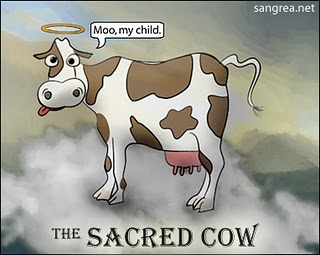
Yet the defense budget -- a misnomer since for Pentagon, Inc. defense per se figures as an afterthought -- remains a sacred cow. Why is that?
The answer lies first in understanding the defenses arrayed around that cow to ensure that it remains untouched and untouchable. Exemplifying what the military likes to call a “defense in depth,” that protective shield consists of four distinct but mutually supporting layers.
Institutional Self-Interest: Victory in World War II produced not peace, but an atmosphere of permanent national security crisis. As never before in U.S. history, threats to the nation’s existence seemed omnipresent, an attitude first born in the late 1940s that still persists today. In Washington, fear -- partly genuine, partly contrived -- triggered a powerful response.
One result was the emergence of the national security state, an array of institutions that depended on (and therefore strove to perpetuate) this atmosphere of crisis to justify their existence, status, prerogatives, and budgetary claims. In addition, a permanent arms industry arose, which soon became a major source of jobs and corporate profits. Politicians of both parties were quick to identify the advantages of aligning with this “military-industrial complex,” as President Eisenhower described it.
Allied with (and feeding off of) this vast apparatus that transformed tax dollars into appropriations, corporate profits, campaign contributions, and votes was an intellectual axis of sorts -- government-supported laboratories, university research institutes, publications, think tanks, and lobbying firms (many staffed by former or would-be senior officials) -- devoted to identifying (or conjuring up) ostensible national security challenges and alarms, always assumed to be serious and getting worse, and then devising responses to them.
The upshot: within Washington, the voices carrying weight in any national security “debate” all share a predisposition for sustaining very high levels of military spending for reasons having increasingly little to do with the well-being of the country.
Strategic Inertia: In a 1948 State Department document, diplomat George F. Kennan offered this observation: “We have about 50 percent of the world's wealth, but only 6.3 percent of its population.” The challenge facing American policymakers, he continued, was “to devise a pattern of relationships that will permit us to maintain this disparity.” Here we have a description of American purposes that is far more candid than all of the rhetoric about promoting freedom and democracy, seeking world peace, or exercising global leadership.
The end of World War II found the United States in a spectacularly privileged position. Not for nothing do Americans remember the immediate postwar era as a Golden Age of middle-class prosperity. Policymakers since Kennan’s time have sought to preserve that globally privileged position. The effort has been a largely futile one.
By 1950 at the latest, those policymakers (with Kennan by then a notable dissenter) had concluded that the possession and deployment of military power held the key to preserving America’s exalted status. The presence of U.S. forces abroad and a demonstrated willingness to intervene, whether overtly or covertly, just about anywhere on the planet would promote stability, ensure U.S. access to markets and resources, and generally serve to enhance the country’s influence in the eyes of friend and foe alike -- this was the idea, at least.
In postwar Europe and postwar Japan, this formula achieved considerable success. Elsewhere -- notably in Korea, Vietnam, Latin America, and (especially after 1980) in the so-called Greater Middle East -- it either produced mixed results or failed catastrophically. Certainly, the events of the post-9/11 era provide little reason to believe that this presence/power-projection paradigm will provide an antidote to the threat posed by violent anti-Western jihadism. If anything, adherence to it is exacerbating the problem by creating ever greater anti-American animus.
One might think that the manifest shortcomings of the presence/power-projection approach -- trillions expended in Iraq for what? -- might stimulate present-day Washington to pose some first-order questions about basic U.S. national security strategy. A certain amount of introspection would seem to be called for. Could, for example, the effort to sustain what remains of America’s privileged status benefit from another approach?
Yet there are few indications that our political leaders, the senior-most echelons of the officer corps, or those who shape opinion outside of government are capable of seriously entertaining any such debate. Whether through ignorance, arrogance, or a lack of imagination, the pre-existing strategic paradigm stubbornly persists; so, too, as if by default do the high levels of military spending that the strategy entails.
Cultural Dissonance: The rise of the Tea Party movement should disabuse any American of the thought that the cleavages produced by the “culture wars” have healed. The cultural upheaval touched off by the 1960s and centered on Vietnam remains unfinished business in this country.
Among other things, the sixties destroyed an American consensus, forged during World War II, about the meaning of patriotism. During the so-called Good War, love of country implied, even required, deference to the state, shown most clearly in the willingness of individuals to accept the government’s authority to mandate military service. GI’s, the vast majority of them draftees, were the embodiment of American patriotism, risking life and limb to defend the country.
The GI of World War II had been an American Everyman. Those soldiers both represented and reflected the values of the nation from which they came (a perception affirmed by the ironic fact that the military adhered to prevailing standards of racial segregation). It was “our army” because that army was “us.”
With Vietnam, things became more complicated. The war’s supporters argued that the World War II tradition still applied: patriotism required deference to the commands of the state. Opponents of the war, especially those facing the prospect of conscription, insisted otherwise. They revived the distinction, formulated a generation earlier by the radical journalist Randolph Bourne, that distinguished between the country and the state. Real patriots, the ones who most truly loved their country, were those who opposed state policies they regarded as misguided, illegal, or immoral.
In many respects, the soldiers who fought the Vietnam War found themselves caught uncomfortably in the center of this dispute. Was the soldier who died in Vietnam a martyr, a tragic figure, or a sap? Who deserved greater admiration: the soldier who fought bravely and uncomplainingly or the one who served and then turned against the war? Or was the war resister -- the one who never served at all -- the real hero?
War’s end left these matters disconcertingly unresolved. President Richard Nixon’s 1971 decision to kill the draft in favor of an All-Volunteer Force, predicated on the notion that the country might be better served with a military that was no longer “us,” only complicated things further. So, too, did the trends in American politics where bona fide war heroes (George H.W. Bush, Bob Dole, John Kerry, and John McCain) routinely lost to opponents whose military credentials were non-existent or exceedingly slight (Bill Clinton, George W. Bush, and Barack Obama), yet who demonstrated once in office a remarkable propensity for expending American blood (none belonging to members of their own families) in places like Somalia, Iraq, and Afghanistan. It was all more than a little unseemly.
Patriotism, once a simple concept, had become both confusing and contentious. What obligations, if any, did patriotism impose? And if the answer was none -- the option Americans seemed increasingly to prefer -- then was patriotism itself still a viable proposition?
Wanting to answer that question in the affirmative -- to distract attention from the fact that patriotism had become little more than an excuse for fireworks displays and taking the occasional day off from work -- people and politicians alike found a way to do so by exalting those Americans actually choosing to serve in uniform. The thinking went this way: soldiers offer living proof that America is a place still worth dying for, that patriotism (at least in some quarters) remains alive and well; by common consent, therefore, soldiers are the nation’s “best,” committed to “something bigger than self” in a land otherwise increasingly absorbed in pursuing a material and narcissistic definition of self-fulfillment.
In effect, soldiers offer much-needed assurance that old-fashioned values still survive, even if confined to a small and unrepresentative segment of American society. Rather than Everyman, today’s warrior has ascended to the status of icon, deemed morally superior to the nation for which he or she fights, the repository of virtues that prop up, however precariously, the nation’s increasingly sketchy claim to singularity.
Politically, therefore, “supporting the troops” has become a categorical imperative across the political spectrum. In theory, such support might find expression in a determination to protect those troops from abuse, and so translate into wariness about committing soldiers to unnecessary or unnecessarily costly wars. In practice, however, “supporting the troops” has found expression in an insistence upon providing the Pentagon with open-ended drawing rights on the nation’s treasury, thereby creating massive barriers to any proposal to affect more than symbolic reductions in military spending.
Misremembered History: The duopoly of American politics no longer allows for a principled anti-interventionist position. Both parties are war parties. They differ mainly in the rationale they devise to argue for interventionism. The Republicans tout liberty; the Democrats emphasize human rights. The results tend to be the same: a penchant for activism that sustains a never-ending demand for high levels of military outlays.
American politics once nourished a lively anti-interventionist tradition. Leading proponents included luminaries such as George Washington and John Quincy Adams. That tradition found its basis not in principled pacifism, a position that has never attracted widespread support in this country, but in pragmatic realism. What happened to that realist tradition? Simply put, World War II killed it -- or at least discredited it. In the intense and divisive debate that occurred in 1939-1941, the anti-interventionists lost, their cause thereafter tarred with the label “isolationism.”
The passage of time has transformed World War II from a massive tragedy into a morality tale, one that casts opponents of intervention as blackguards. Whether explicitly or implicitly, the debate over how the United States should respond to some ostensible threat -- Iraq in 2003, Iran today -- replays the debate finally ended by the events of December 7, 1941. To express skepticism about the necessity and prudence of using military power is to invite the charge of being an appeaser or an isolationist. Few politicians or individuals aspiring to power will risk the consequences of being tagged with that label.
In this sense, American politics remains stuck in the 1930s -- always discovering a new Hitler, always privileging Churchillian rhetoric -- even though the circumstances in which we live today bear scant resemblance to that earlier time. There was only one Hitler and he’s long dead. As for Churchill, his achievements and legacy are far more mixed than his battalions of defenders are willing to acknowledge. And if any one figure deserves particular credit for demolishing Hitler’s Reich and winning World War II, it’s Josef Stalin, a dictator as vile and murderous as Hitler himself.
Until Americans accept these facts, until they come to a more nuanced view of World War II that takes fully into account the political and moral implications of the U.S. alliance with the Soviet Union and the U.S. campaign of obliteration bombing directed against Germany and Japan, the mythic version of “the Good War” will continue to provide glib justifications for continuing to dodge that perennial question: How much is enough?
Like concentric security barriers arrayed around the Pentagon, these four factors -- institutional self-interest, strategic inertia, cultural dissonance, and misremembered history -- insulate the military budget from serious scrutiny. For advocates of a militarized approach to policy, they provide invaluable assets, to be defended at all costs.
Andrew J. Bacevich is professor of history and international relations at Boston University. His most recent book is Washington Rules: America’s Path to Permanent War. To listen to Timothy MacBain's latest TomCast audio interview in which Bacevich discusses the money that pours into the national security budget, click here or, to download it to your iPod, here.
Copyright 2011 Andrew Bacevich
COMMENT:anthony innes · 2 days ago
hitler was a creation of the industrialists and the army.
their psycho puppet got away from them and it took years of war to get the controls back.
the financiers who play both ends against the middle got what was wanted and now we get what that is all about.
What next?
The pentagon fantasy of full spectrum dominance has been achieved and now the next human collective insanity will be run.
The concept of ethical journalism is the public is bombarded with facts until fission occurs.
The WWW is enabling a brief moment of lucidity before another tragic lapse into psychosis.humanbeing · 2 days ago

Isn't the question, how many people are employed by the US war machine? That includes all those employed by weapons manufacturers, mercenaries, war profiteers like Haliburton, not to mention the entire Defense Department, Homeland Security Department, the CIA, and all the other spy organizations and defense related "think-tanks". That has got to be by far the largest source of employment in the world. Then add on all the foreigners paid by the US war machine. The US war machine is simply way too big to fail. Talk about the failure of large banks undermining the world economy, the US war machine is way larger than the banks, in fact the banks are part of the war machine - they finance a lot of it.
War, weapons, destruction, spy games, are not only the US' largest export, but one of its very few significant exports.
The only thing that can reduce this testosterone driven monster of world destruction, is to transfer most of those jobs to space programs, clean energy, and infrastructure development.