| THE HANDSTAND | FEB.MARCH2011 |
The NATO Plan is to Occupy Libya
By Fidel Castro
February 23, 2011 "Escambray" -- -Oil has become the principal wealth in the hands of the great Yankee transnationals; through this energy source they had an instrument that considerably expanded their political power in the world. It was their main weapon when they decided to easily liquidate the Cuban Revolution as soon as the first just and sovereign laws were passed in our Homeland: depriving it of oil.
Upon this energy source today’s civilization was developed. Venezuela was the nation in this hemisphere that paid the highest price. The United States became the lord and master of the huge oil fields that Mother Nature had bestowed upon that sister country.
At the end of the last World War, it started to extract greater amounts of oil from the oil fields of Iran, as well as those in Saudi Arabia, Iraq and the Arab countries located around them. These became the main suppliers. World consumption progressively increased to the fabulous figure of approximately 80 million barrels a day, including those being extracted on United States territory, to which later gas, hydro and nuclear energies were added. Until the beginning of the twentieth century, coal had been the basic source of energy that made industrial development possible, before billions of automobiles and engines consuming the liquid fuel were produced.
The squandering of oil and gas is associated with one of the greatest tragedies, not in the least resolved, which is suffered by humankind: climate change.
When our Revolution arose, Algeria, Libya and Egypt were not yet oil producers and a great part of the abundant reserves of Saudi Arabia, Iraq, Iran and the United Arab Emirates were still to be discovered.
In December of 1951, Libya becomes the first African country to attain its independence after WW II, during which its territory was the stage for important battles between the troops of Germany and the United Kingdom, conferring fame and glory on Generals Erwin Rommel and Bernard L. Montgomery.
Ninety-five percent of its territory is completely made up of desert. Technology permitted the discovery of vital oilfields of excellent quality light oil that today reach one million 800 thousand barrels a day along with abundant deposits of natural gas. Such riches allowed it to reach life expectancy that is almost at 75 years of age and the highest per capita income in Africa. Its harsh desert is located over an enormous lake of fossil waters, equivalent to more than three times the land area of Cuba; this has made it possible to construct a broad network of pipelines of fresh water that stretch from one end of the country to the other.
Libya, which had a million inhabitants when it attained independence, today has somewhat more than 6 million.
The Libyan Revolution took place in the month of September of the year 1969. Its main leader was Muammar al-Gaddafi, a soldier of Bedouin origin who, in his early years, was inspired by the ideas of the Egyptian leader Gamal Abdel Nasser. Without any doubt, many of his decisions are associated with the changes that were produced when, as in Egypt, a weak and corrupt monarchy was overthrown in Libya.
The inhabitants of that country have age-old warrior traditions. It is said that ancient Libyans were a part of Hannibal’s army when he was at the point of destroying Ancient Rome with the troops that crossed the Alps.
One can agree with Gaddafi or not. The world has been invaded with all kinds of news, especially using the mass media. One has to wait the necessary length of time in order to learn precisely what is the truth and what are lies, or a mixture of events of every kind that, in the midst of chaos, were produced in Libya. For me, what is absolutely clear is that the government of the United States is not in the least worried about peace in Libya and it will not hesitate in giving NATO the order to invade that rich country, perhaps in a matter of hours or a few short days.
Those who with perfidious intentions invented the lie that Gaddafi was headed for Venezuela, just as they did yesterday afternoon on Sunday the 20th of February, today received an fitting response from Foreign Affairs Minister Nicolás Maduro when he literally stated that he was “wishing that the Libyan people would find, in the exercise of their sovereignty, a peaceful solution to their difficulties, that would preserve the integrity of the Libyan people and nation, without the interference of imperialism...”
As for me, I cannot imagine that the Libyan leader would abandon his country; escaping the responsibilities he is charged with, whether or not they are partially or totally false.
An honest person shall always be against any injustice being committed against any people in the world, and the worst of all, at this moment, would be to remain silent in the face of the crime that NATO is getting ready to commit against the Libyan people.
The leadership of that war-mongering organization has to do it. We must condemn it!
Fidel Castro Ruz - February 21, 2011
Obama breaks silence, condemns Libya crackdown
Related Video

U.S. preparing full range of options on Libya: Obama
President Barack Obama speaks about Libya while U.S. Secretary of State Hillary Clinton listens in the White House in Washington February 23, 2011.
Credit: Reuters/Kevin Lamarque By Alister Bull and Arshad Mohammed
WASHINGTON |
WASHINGTON (Reuters) - President Barack Obama condemned the "outrageous" crackdown by Libyan security forces on protesters and said Washington would work with international partners to hold Muammar Gaddafi's government accountable."The suffering and bloodshed is outrageous and it is unacceptable. So are threats and orders to shoot peaceful protesters," Obama said in his first public comments on the violence in Libya. He did not directly criticize Gaddafi and he stopped short of backing sanctions against the oil-producing North African country.
Obama, the first U.S. president to meet Gaddafi, has faced criticism in some quarters for not speaking out sooner, but U.S. officials say they have tempered their response to ensure thousands of Americans in Libya can be safely evacuated. "We are doing everything we can to protect American citizens. It is my highest priority," Obama said at the White House. Obama spoke as a U.S.-government chartered ferry prepared to evacuate Americans and other foreigners to the island of Malta in the Mediterranean. The U.S. government estimates there are several thousand Americans living in Libya. Most hold dual citizenship with about 600 carrying U.S. passports only.
State Department spokesman P.J. Crowley said high seas were delaying the ferry's departure. "Citizens are safe on board. It will leave when the weather permits," he tweeted.After days of cautious statements on the turmoil in Libya, U.S. officials steadily ratcheted up their rhetoric on Wednesday.Crowley said sanctions and freezing Libyan assets, including those belonging to Gaddafi, were among the options being considered by the United States. Sanctions alone would not have much impact -- U.S. exports to Libya were only $665 million in 2010, while U.S. aid amounted to less than $1 million. Analysts say getting international agreement on such measures will likely be difficult and take time.Obama said he had ordered his national security team to prepare the full range of options for dealing with the crisis. "It is imperative that the nations and peoples of the world speak with one voice," he said.
(Additional reporting by Caren Bohan, Phil Stewart, Matt Spetalnick, Jeff Mason, Paul Eckert, Andrew Quinn and Patricia Zengerle; Writing by Ross Colvin; Editing by Philip Barbara)

Photo by: ASSOCIATED PRESSLibya: 2,000 reported killed in Benghazi, 1,000 in Tripoli
By ASSOCIATED PRESS AND JPOST.COM STAFF
02/23/2011 19:32
Talkbacks (5) Militiamen loyal to Moammar Gaddafi clamped down in Tripoli, with the sound of gunfire ringing in the air, while protesters who control much of the eastern half of Libya claimed new gains in cities and towns closer to the heart of Gaddafi's regime in the capital.
Protesters said they had taken over Misrata, which would be the largest city in the western half in the country to fall into their hands. Clashes broke out over the past two days in the town of Sabratha, west of the capital, where the army and militiamen were trying to put down protesters who overwhelmed security headquarters and government buildings, a news website close to the government reported.
RELATED:
WikiLeaks cables portray Gaddafi as a master manipulator
'Gaddafi orders explosion of Libya's oil pipelines'
A French doctor working in Libya's eastern city of Benghazi told Le Point Magazine that over 2,000 people were killed in that city alone in the past days of fighting, AFP reported.
"From Tobruk to Darna, they carried out a real massacre... In total, I think there are more than 2,000 deaths," he said.
The 60-year-old anesthetist who has been living in the Libyan city for over a year, said that one the first day of fighting in Benghazi, "out ambulances counted 75 bodies...200 on the second [day], then more than 500." On the third day, he added, "I ran out of morphine and medications," according to the report.
Two air force pilots jumped from parachutes from their Russian-made Sukhoi fighter jet and let it crash, rather than carry out orders to bomb Libya's second largest city, Benghazi, which is now in opposition hands, the website Quryna reported, citing an unidentified officer in the air force control room.
One of the pilots was from Gaddafi's tribe, the Gadhadhfa, said Farag al-Maghrabi, a local resident who saw the pilots and the wreckage of the jet, which crashed in a deserted area outside the key oil port of Breqa.
International outrage mounted after Gaddafi on Tuesday went on state TV and in a fist-pounding speech called on his supporters to take to the streets to fight protesters. Gaddafi's retaliation has already been the harshest in the Arab world to the wave of anti-government protests sweeping the Middle East.
Italy's Foreign Minister Franco Frattini said estimates of some 1,000 people killed in the violence in Libya were "credible," although he stressed information about casualties was incomplete. The New York-based Human Rights Watch has put the death toll at nearly 300, according to a partial count.
Gaddafi's speech appeared to have brought out a heavy force of supporters and militiamen that largely prevented major protests in the capital Tuesday night or Wednesday. Through the night, gunfire was heard, said one woman who lives near downtown.
"Mercenaries are everywhere with weapons. You can't open a window or door. Snipers hunt people," she said. "We are under siege, at the mercy of a man who is not a Muslim."
During the day Wednesday, more gunfire was heard near Gaddafi's residence, but in many parts of the city of 2 million residents were venturing out to stores, some residents said. The government sent out text messages urging people to go back to their jobs, aiming to show that life was returning to normal. The residents spoke on condition of anonymity for fear of retaliation.
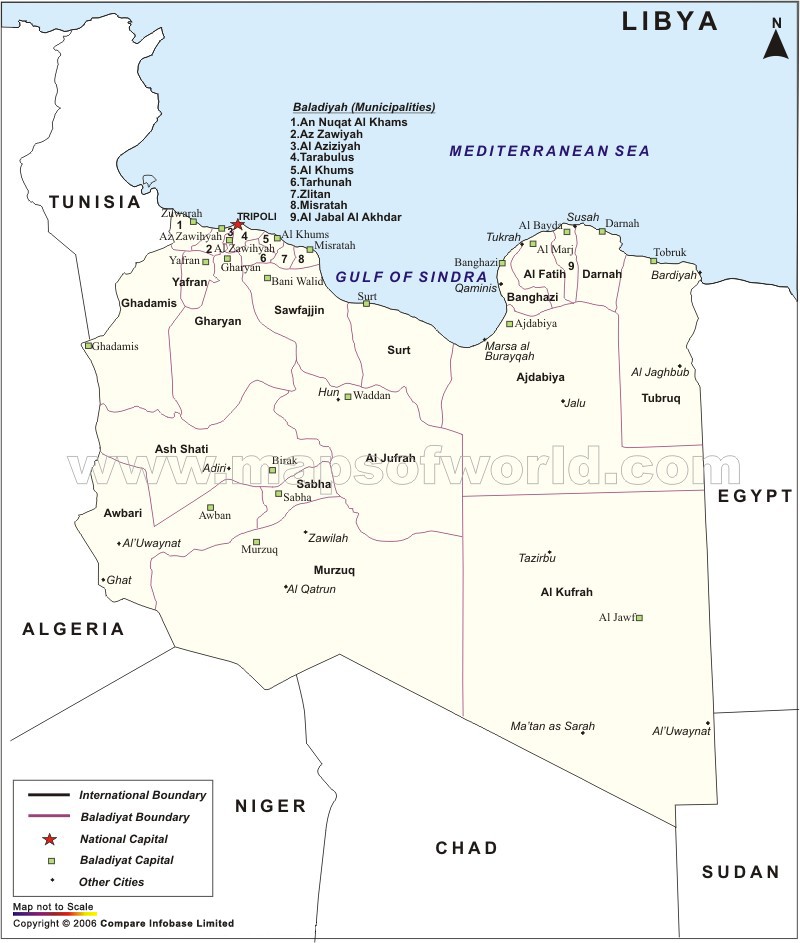
But Libya's upheaval, just over a week old, has shattered the hold of Gaddafi's regime across much of the country. Protesters claim to hold towns and cities along nearly the entire eastern half of the 1,000-mile Mediterranean coastline, from the Egyptian border. In parts, they have set up their own jury-rigged self-administrations.
At the Egyptian border, guards had fled, and local tribal elders have formed local committees to take their place. "Welcome to the new Libya," a graffiti spray-painted at the crossing proclaimed. Fawzy Ignashy, a former soldier, now in civilian clothes at the border, said that early in the protests, some commanders ordered troops to fire on protesters, but then tribal leaders stepped in and ordered them to stop.
"They did because they were from here. So the officers fled," he said.
Protesters have claimed control all the way to the city of Ajdabiya, about 480 miles (800 kilometers) east of Tripoli, encroaching on the key oil fields around the Gulf of Sidra.
That has left Gaddafi's power centered around Tripoli, in the far west and parts of the country's center. But that appeared to be weakening in parts.
Protesters in Misrata were claiming victory after several days of fighting with Gaddafi loyalists in the city, about 120 miles (200 kilometers) east of Tripoli.
Residents were honking horns in celebration and raising the pre-Gaddafi flags of the Libyan monarchy, said Faraj al-Misrati, a local doctor. He said six people had been killed and 200 wounded in clashes that began Feb. 18 and eventually drove out pro-Gaddafi militiamen.
An audio statement posted on the Internet was reportedly from armed forces officers in Misrata proclaiming "our total support" for the protesters.
New videos posted by Libya's opposition on Facebook also showed scores of anti-government protesters raising the flag from the pre-Gaddafi monarchy on a building in Zawiya, 30 miles (50 kilometers) west of Tripoli. Another showed protesters lining up cement blocks and setting tires ablaze to fortify positions on a square inside the capital.
The footage couldn't be independently confirmed.
Further west, armed forces deployed in Sabratha, a town famed for nearby ancient Roman ruins, in a bid to regain control after protesters burned government buildings and police stations, the Quryna news website reported. It said clashes had erupted between soldiers and residents in the past nights and that residents were also reporting an influx of pro-Gaddafi militias that have led heaviest crackdown on protesters.
The opposition also claimed control in Zwara, about 30 miles (50 kilometers) from the Tunisian border in the west, after local army units sided with the protesters and police fled.
"The situation here is very secure, the people here have organized security committees, and there are people who have joined us from the army," said a 25-year-old unemployed university graduate in Zwara. "This man (Gaddafi) has reached the point that he's saying he will bring armies from African (to fight protesters). That means he is isolated," he said.
The division of the country — and defection of some army units to the protesters — raises the possibility the opposition could try an assault on the capital. On the Internet, there were calls by protesters for all policemen, armed forces and youth to march to Tripoli on Friday.
In his speech Tuesday night, Gaddafi defiantly vowed to fight to his "last drop of blood" and roared at supporters to strike back against Libyan protesters to defend his embattled regime.
"You men and women who love Gaddafi... get out of your homes and fill the streets," Gaddafi said. "Leave your homes and attack them in their lairs."
Gaddafi appears to have lost the support of several tribes and his own diplomats, including Libya's ambassador in Washington, Ali Adjali, and deputy UN Ambassador Ibrahim Dabbashi.
International alarm has risen over the crisis, which sent oil prices soaring to the highest level in more than two years on Tuesday and sparked a scramble by European and other countries to get their citizens out of the North African nation. The UN Security Council held an emergency meeting that ended with a statement condemning the crackdown, expressing "grave concern" and calling for an "immediate end to the violence" and steps to address the legitimate demands of the Libyan people.
French President Nicolas Sarkozy also pressed Wednesday for European Union sanctions against Libya's regime because of its violent crackdown on protesters, and raised the possibility of cutting all economic and business ties between the EU and the North African nation.
"The continuing brutal and bloody repression against the Libyan civilian population is revolting," Sarkozy said in a statement. "The international community cannot remain a spectator to these massive violations of human rights."
Italian news reports have said witnesses and hospital sources in Libya are estimating there are 1,000 dead in Tripoli, the Libyan capital, alone.
"We have no complete information about the number of people who have died," Frattini said in a speech to a Catholic organization in Rome ahead of a briefing in Parliament on Libya. "We believe that the estimates of about 1,000 are credible."
Libya is the biggest supplier of oil to Italy, which has extensive energy, construction and other business interests in the north African country and decades of strong ties.
Frattini said the Italian government is asking that the "horrible bloodshed" cease immediately.
- Gaddafi loses more Libyan cities
23 Feb 2011
Protesters wrest control of more cities as unrest sweeps African nation despite Muammar Gaddafi's threat of crackdown.
Muammar Gaddafi, Libya's long-standing ruler, has reportedly lost control of more cities as anti-government protests continue to sweep the African nation despite his threat of a brutal crackdown.
Protesters in Misurata said on Wednesday they had wrested the western city from government control. In a statement on the internet, army officers stationed in the city pledged "total support for the protesters".
The protesters also seemed to be in control of much of the country's east, and an Al Jazeera correspondent, reporting from the city of Tobruk, 140km from the Egyptian border, said there was no presence of security forces.
"From what I've seen, I'd say the people of eastern Libya are the ones in control," Hoda Abdel-Hamid, our correspondent, said.
She said there were no officials manning the border when the Al Jazeera team crossed into Libya.
'People in charge'
"All along the border, we didn't see one policeman, we didn't see one soldier and people here told us they [security forces] have all fled or are in hiding and that the people are now in charge, meaning all the way from the border, Tobruk, and then all the way up to Benghazi.
"People tell me it's also quite calm in Bayda and Benghazi. They do say, however, that 'militias' are roaming around, especially at night. They describe them as African men, they say they speak French so they think they're from Chad."
Major-General Suleiman Mahmoud, the commander of the armed forces in Tobruk, told Al Jazeera that the troops led by him had switched loyalties.
"We are on the side of the people," he said. "I was with him [Gaddafi] in the past but the situation has changed - he's a tyrant."
Benghazi, Libya's second largest city, was where people first rose up in revolt against Gaddafi's 42-year long rule more than a week ago. The rebellion has since spread to other cities despite heavy-handed attempts by security forces to quell the unrest.
With authorities placing tight restrictions on the media, flow of news from Libya is at best patchy. But reports filtering out suggest at least 300 people have been killed in the violence.
But Franco Frattini, the Italian foreign minister, said there were "credible' reports that at least 1,000 had died in the clampdown.
Defiant Gaddafi
Amid the turmoil, a defiant Gaddafi has vowed to quash the uprising.
He delivered a rambling speech on television on Tuesday night, declaring he would die a martyr in Libya, and threatening to purge opponents "house by house" and "inch by inch".
He blamed the uprising in the country on "Islamists", and warned that an "Islamic emirate" has already been set up in Bayda and Derna, where he threatened the use of extreme force.