| THE HANDSTAND | FEB.-MARCH2011 |
EGYPT UPDATES- future updates will be added to head of this column
Interview - Gareth Porter Investigative Journalist with www.PressTV.com
The US will continue efforts to maintain Egypt's collaborations with Washington and Tel Aviv as it is
unlikely that the US stops putting pressure on those opposing Israel, a journalist says.
In an interview with Press TV, Gareth Porter said, ''Unless there is a totally surprising decision made in Washington to abandon its regional strategy, which has, for three decades or so, been devoted to unremitting pressure on those states and parties which have opposed Israel and its role in relation to Palestinians, as well as its role in the region," the US will continue to "try to use whatever instruments of power available to it in Egypt to try to keep that country as much as possible on a track that is collaborative with the United States and Israel."
He said US efforts to keep control over Egypt's politics will be a source of tension for the next six months to come following the Egyptian revolution.
“One must assume that the interest of the military regime, particularly one which is headed by the person who was the primary collaborator of the United States' CIA in this rendition program, is going to have a different set of priorities and different set of interests from those of the pro-democracy demonstrators in Egypt,” Porter added.
“Therefore, we are going to see a long period here of very intricate maneuvering between the government headed by the former intelligence chief of Egypt and the forces, which were involved in the pro-democracy demonstrations,” he added.
While Muslims account for the majority of Egypt's population, the West has criticized those amending the Egyptian constitution for refusing to remove Article 2, stating that Islam is the state religion and recognizing the Shariah as the source of law.
Porter said that the US and Israel are interested in “pushing Egypt in a different direction … to fence off Islamic influence, the influence of Islamist parties and particularly the Muslim Brotherhood in Egypt.”
The issue is not one of simply Egyptian political forces within the country's borders, but “also involve external forces, as well.”
SZH/PKH/AKM
- Congratulations to Egypt for this success in your revolution and may further measures to have a civilian government be brought about to ensure the complete success of your brave and resolute action.
- february 11th
Vice president: Mubarak steps down Published today (updated) 11/02/2011 18:52[AFP/Egyptian TV] CAIRO (AFP) -- Egyptian President Hosni Mubarak has stepped down and handed over power to the army, his deputy Omar Suleiman announced Friday in a televised address. Cairo erupted with joyful dancing, singing and cries of "Allahu Akbar" [God is Greatest] as Mubarak's 30-year rule comes to an end following more than two weeks of mass protests.
Hamas hailed the "start of the victory of the Egyptian revolution." The EU said Mubarak "listened to the voices" of Egypt's people. US President Barack Obama was to make a televised statement.
Wall Street stocks jumped on Mubarak's resignation. US stocks surged, with the Dow moving from an early slight loss to add 0.30 percent, while the Nasdaq also rose 0.30 percent.
"Mubarak has left Cairo with all his family," the source said, but refused to say whether the president had left the country or was headed to his residence in the Red Sea resort of Sharm El-Sheikh. He left Cairo with his family, a source close to the government said, but his destination was not clear.
- **********************************************************************
- « Yasmeen El KhoudaryTuesdayFeb082011
Listen to your people ya Hosni
Video of pro democracy activist - Tahir Square
**********************************************************************
Received 9th February: http://www.presstv.com/detail/164239.html
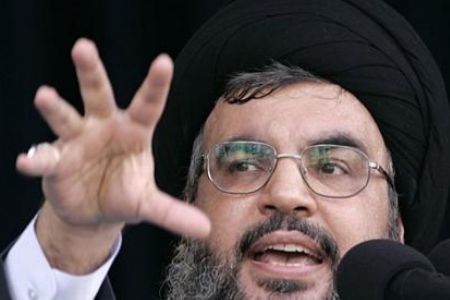
General Sayyed Hassan Nasrallah Hezbollah Secretary has revealed to the Arab and Islamic world another Israeli “scenario” regarding the Egyptian revolution.
“Israel is putting pressure on every political circle in the world to protect Mubarak's regime,” Nasrallah said in his speech on Monday.
He noted that the recent revolutions in Egypt and Tunisia have made Israel “reconsider its national security strategies” as it finds itself isolated in the Middle East after losing its regional allies, one by one.
Nasrallah warned that some accuse the Tunisian and Egyptian revolutions of being the creations of the United States and its military and intelligence agencies.
The Hezbollah chief described such accusations as “unjust and an insult” to both North African nations.
“Who can believe that the US is deliberately trying to overthrow a regime that meets all the demands of the US administration, a regime which is protecting US interests and projects in the region?” he argued.
Nasrallah also warned the people and all resistance movements, “They (the US) are trying to present themselves as if they defend the people and their rights and will, after years of supporting one of the worst dictatorships that we have seen in our region.”
As public opinion polls conducted by US academic institutions show, the majority of the people in the region are against US policies.Received 8thFebruary 2011 U.S.Envoy's Business Links to Egypt:
US envoy's business link to Egypt
Obama scrambles to limit damage after Frank Wisner makes robust call for Mubarak to remain in place as leader.
Monday, 7 February 2011
EPA
Mr Wisner is a retired State Department 36-year "career" diplomat ? in otherwords, he was not a political appointee
Frank Wisner, President Barack Obama's envoy to Cairo who infuriated the White House this weekend by urging Hosni Mubarak to remain President of Egypt, works for a New York and Washington law firm which works for the dictator's own Egyptian government.
Mr Wisner's astonishing remarks – "President Mubarak's continued leadership is critical: it's his opportunity to write his own legacy" – shocked the democratic opposition in Egypt and called into question Mr Obama's judgement, as well as that of Secretary of State Hillary Clinton.
The US State Department and Mr Wisner himself have now both claimed that his remarks were made in a "personal capacity". But there is nothing "personal" about Mr Wisner's connections with the litigation firm Patton Boggs, which openly boasts that it advises "the Egyptian military, the Egyptian Economic Development Agency, and has handled arbitrations and litigation on the [Mubarak] government's behalf in Europe and the US". Oddly, not a single journalist raised this extraordinary connection with US government officials – nor the blatant conflict of interest it appears to represent.
Mr Wisner is a retired State Department 36-year career diplomat – he served as US ambassador to Egypt, Zambia, the Philippines and India under eight American presidents. In other words, he was not a political appointee. But it is inconceivable Hillary Clinton did not know of his employment by a company that works for the very dictator which Mr Wisner now defends in the face of a massive democratic opposition in Egypt.
So why on earth was he sent to talk to Mubarak, who is in effect a client of Mr Wisner's current employers?
Patton Boggs states that its attorneys "represent some of the leading Egyptian commercial families and their companies" and "have been involved in oil and gas and telecommunications infrastructure projects on their behalf". One of its partners served as chairman of the US-Egyptian Chamber of Commerce promoting foreign investment in the Egyptian economy. The company has also managed contractor disputes in military-sales agreements arising under the US Foreign Military Sales Act. Washington gives around $1.3bn (£800m) a year to the Egyptian military.
Mr Wisner joined Patton Boggs almost two years ago – more than enough time for both the White House and the State Department to learn of his company's intimate connections with the Mubarak regime. The New York Times ran a glowing profile of Mr Wisner in its pages two weeks ago – but mysteriously did not mention his ties to Egypt.
Nicholas Noe, an American political researcher now based in Beirut, has spent weeks investigating Mr Wisner's links to Patton Boggs. Mr Noe is also a former researcher for Hillary Clinton and questions the implications of his discoveries.
"The key problem with Wisner being sent to Cairo at the behest of Hillary," he says, "is the conflict-of-interest aspect... More than this, the idea that the US is now subcontracting or 'privatising' crisis management is another problem. Do the US lack diplomats?
"Even in past examples where presidents have sent someone 'respected' or 'close' to a foreign leader in order to lubricate an exit," Mr Noe adds, "the envoys in question were not actually paid by the leader they were supposed to squeeze out!"
Patton Boggs maintains an "affiliate relationship" with Zaki Hashem, one of Egypt's most prominent legal firms. It was founded in 1953 and Zaki Hashem himself was a cabinet minister under Mubarak's predecessor, President Anwar Sadat, and later became head of the Egyptian Society for International Law.
By a further remarkable irony, one of Zaki Hashem's senior advisers was Nabil al-Araby, one of the 25 leading Egyptian personalities just chosen by the protesters in Tahrir Square to demand the overthrow of Mubarak. Nabil al-Araby, a former member of the UN's International Law Commission, told me yesterday that he ended his connection with Zaki Hashem three years ago and had "no idea" why Mr Wisner had come out in support of Mubarak's continued rule. He himself believed it was essential Mubarak make a dignified but immediate exit. "The head must go," he said.
When Frank Wisner joined Patton Boggs in March 2009, the company described him as "one of the nation's most respected diplomats" who would provide clients with "strategic global advice concerning business, politics and international law". The firm stated specifically that "it looks to Ambassador Wisner to use his expertise in the Middle East and India to assist its American and international clients."
Stuart Pape, managing partner at Patton Boggs, said at the time that "it is a real coup for the firm to have Ambassador Wisner – one of the most experienced and highly regarded diplomats – join our ranks... His in-depth knowledge of global politics and the international financial world is a huge asset for our clients."
We still do not know exactly what kind of "expertise" he has bestowed upon the dictator of Egypt. But his remarks at the weekend leave no room to doubt he advised the old man to cling on to power for a few more months. The vast network of companies with family connections to Mubarak's regime is, of course, one of the targets of the pro-democracy demonstrators in Egypt.
A spokesman for the State Department said he "presumed" Mrs Clinton knew of Mr Wisner's employment by Patton Boggs and the firm's links with the Mubarak government, but refused to comment on any conflict of interest for the envoy. A spokesman for Patton Boggs could not be reached yesterday.
Like Robert Fisk on The Independent on Facebook for updates
NEW: (Feb.8th)
Egyptians staged one of their biggest protests yet today demanding President Hosni Mubarak step down now, their wrath undiminished by the vice president's announcement of a plan to transfer power. Protesters, many moved by a Google executive's tearful account of detention by Mubarak's state security, poured into Cairo's Tahrir Square to pack a space that can take a quarter of a million people.
While the government refuses to budge on the demonstrators' main demands, Vice President Omar Suleiman promised there would be no reprisals against the protesters for their campaign now entering a third week to eject Mubarak after 30 years in office. But they dismissed his promises, accusing the government of playing for time, and swore they would not give up until the current "half revolution" was complete.
Wael Ghonim, the Google executive whose tears in a television interview appear to have boosted today's turnout significantly, addressed the cheering crowd in a protest movement that has yet to produce a leader. "You are the heroes. I am not a hero, you are the heroes," said Ghonim, who had described on Monday night being blindfolded by state security during his 12 days in detention. Activists say Ghonim was behind a Facebook group that helped to inspire the wave of protests. His interview also appears to have persuaded many Egyptians to side with the protests. "Ghonim's tears have moved millions and turned around the views of those who supported (Mubarak) staying," website Masrawy.com wrote two hours after the interview. In that short span, 70,000 people signed up to Facebook pages supporting him. Later Ghonim expressed his sorrow for the victims of the violence that has claimed an estimated 300 lives during the current wave of protests.
"My condolences to the fathers and mothers who lost sons and daughters who died for their dream," he told Reuters. "I saw young people dying and now the president has a responsibility to see what the people demand," he said, adding that these demands include Mubarak, 82, stepping down.
Received 8th February 2011:Whither Egypt? Interview with Gilbert Achcar
Whither Egypt?
By Gilbert Achcar and Farooq Sulehria
Saturday, February 05, 2011
To help explain the thrilling developments in Egypt, Farooq Sulehria interviewed leading Arab scholar-activist Gilbert Achcar on February 4.
Do you think that Mubarak's pledge on February 1st not to contest the next election represented a victory for the movement, or was it just a trick to calm down the masses as on the very next day demonstrators in Al-Tahrir Square were brutally attacked by pro-Mubarak forces?
The Egyptian popular anti-regime uprising reached a first peak on February 1st, prodding Mubarak to announce concessions in the evening. It was an acknowledgement of the force of the popular protest and a clear retreat on the autocrat's part, coming on top of the announcement of the government's willingness to negotiate with the opposition. These were significant concessions indeed coming from such an authoritarian regime, and a testimony to the importance of the popular mobilisation. Mubarak even pledged to speed up ongoing judicial actions against fraud perpetrated during the previous parliamentary elections.
He made it clear, however, that he was not willing to go beyond that. With the army firmly on his side, he was trying to appease the mass movement, as well as the Western powers that were urging him to reform the political system. Short of resignation, he granted some of the key demands that the Egyptian protest movement had formulated initially, when it launched its campaign on January 25. However, the movement has radicalized since that day to a point where anything short of Mubarak's resignation won't be enough to satisfy it, with many in the movement even demanding that he gets tried in court.
Moreover, all the regime's key institutions are now denounced by the movement as illegitimate––the executive as well as the legislative, i.e. the parliament. As a result, part of the opposition is demanding that the head of the constitutional court be appointed as interim president, to preside over the election of a constituent assembly. Others even want a national committee of opposition forces to supervise the transition. Of course, these demands constitute a radical democratic perspective. In order to impose such a thorough change, the mass movement would need to break or destabilise the regime's backbone, that is the Egyptian army.
Do you mean that the Egyptian army is backing Mubarak?
Egypt––even more than comparable countries such as Pakistan or Turkey––is in essence a military dictatorship with a civilian façade that is itself stuffed with men originating in the military. The problem is that most of the Egyptian opposition, starting with the Muslim Brotherhood, have been sowing illusions about the army and its purported "neutrality," if not "benevolence." They have been depicting the army as an honest broker, while the truth is that the army as an institution is not "neutral" at all. If it has not been used yet to repress the movement, it is only because Mubarak and the general staff did not see it appropriate to resort to such a move, probably because they fear that the soldiers would be reluctant to carry out a repression. That is why the regime resorted instead to orchestrating counter-demonstrations and attacks by thugs on the protest movement. The regime tried to set up a semblance of civil strife, showing Egypt as torn apart between two camps, thus creating a justification for the army's intervention as the "arbiter" of the situation.
If the regime managed to mobilise a significant counter-movement and provoke clashes on a larger scale, the army could step in, saying: "Game over, everybody must go home now," while promising that the pledges made by Mubarak would be implemented. Like many observers, I feared these last two days that this stratagem might succeed in weakening the protest movement, but the huge mobilization of today's "day of departure" is reassuring. The army will need to make further and more significant concessions to the popular uprising.
When you talk of the opposition, what forces does it include? Of course, we hear about the Muslim Brotherhood and El Baradei. Are there are other players too like left wing forces, trade unions, etc?
The Egyptian opposition includes a vast array of forces. There are parties like the Wafd, which are legal parties and constitute what may be called the liberal opposition. Then there is a grey zone occupied by the Muslim Brotherhood. It does not have a legal status but is tolerated by the regime. Its whole structure is visible; it is not an underground force. The Muslim Brotherhood is certainly, and by far, the largest force in the opposition. When Mubarak's regime, under US pressure, granted some space to the opposition in the 2005 parliamentary elections, the Muslim Brotherhood––running as "independents"––managed to get 88 MPs, i.e. 20 percent of the parliamentary seats, despite all obstacles. In the last elections held last November and December, after the Mubarak regime had decided to close down the limited space that it had opened in 2005, the Muslim Brotherhood almost vanished from parliament, losing all its seats but one.
Among the forces on the left, the largest is the Tagammu party, which enjoys a legal status and has 5 MPs. It refers to the Nasserite legacy. Communists have been prominent within its ranks. It is basically a reformist left party, which is not considered a threat to the regime. On the contrary, it has been quite compliant with it on several occasions. There are also leftwing Nasserite and radical left groups in Egypt––small but vibrant, and very much involved in the mass movement.
Then there are "civil society" movements, like Kefaya, a coalition of activists from various opposition forces initiated in solidarity with the Second Palestinian Intifada in 2000. It opposed the invasion of Iraq later on, and became famous afterwards as a democratic campaign movement against Mubarak's regime. From 2006 to 2009, Egypt saw the unfolding of a wave of industrial actions, including a few impressively massive workers strikes. There are no independent workers unions in Egypt, with one or two very recent exceptions born as a result of the social radicalisation. The bulk of the working class does not have the benefit of autonomous representation and organization. An attempt at convening a general strike on April 6, 2008 in solidarity with the workers led to the creation of the April 6 Youth Movement. Associations like this one and Kefaya are campaign-focused groups, not political parties, and they include people of different political affiliations along with unaffiliated activists.
When Mohamed El Baradei returned to Egypt in 2009 after his third term at the head of the IAEA, his personal prestige enhanced by the 2005 Nobel Peace Prize, a liberal and left coalition gathered around him, with the Muslim Brotherhood adopting a lukewarm reserved position. Many in the opposition saw El Baradei as a powerful candidate enjoying international reputation and connections, and constituting therefore a credible presidential candidate against Mubarak or his son. El Baradei thus became a rallying figure for a large section of the opposition, regrouping political forces as well as personalities. They formed the National Association for Change.
This whole array of forces is very much involved in the present uprising. However, the overwhelming majority of the people on the streets are without any sort of political affiliation. It is a huge mass outpouring of resentment at living under a despotic regime, fed by worsening economic conditions, as prices of basic necessities, like food, fuel, and electricity, have been sharply on the rise amid staggering joblessness. This is the case not only in Egypt but in most of the region as well, and that is why the fire of revolt that started in Tunisia spread so quickly to many Arab countries.
Is El Baradei genuinely popular, or is he in some way the Mir-Hossein Mousavi of the Egyptian movement, trying to change some faces while preserving the regime?
I would disagree with this characterisation of Mousavi in the first place. To be sure, Mir-Hossein Mousavi did not want to "change the regime" if one mean by that a social revolution. But there was definitely a clash between authoritarian social forces, spearheaded by the Pasdaran and represented by Ahmedinejad, and others coalesced around a liberal reformist perspective represented by Mousavi. It was indeed a clash about the kind of "regime" in the sense of the pattern of political rule.
Mohamed El Baradei is a genuine liberal who wishes his country to move from the present dictatorship to a liberal democratic regime, with free elections and political freedoms. If such a vast array of political forces is willing to cooperate with him, it is because they see in him the most credible liberal alternative to the existing regime, a man who does not command an organised constituency of his own, and is therefore an appropriate figurehead for a democratic change.
Going back to your analogy, you can't compare him with Mousavi who was a member of the Iranian regime, one of the men who led the 1979 Islamic revolution. Mousavi had his own followers in Iran, before he emerged as the leader of the 2009 mass protest movement. In Egypt, El Baradei cannot play, and does not pretend to play a similar role. He is supported by a vast array of forces, but none of them see him as its leader.
The Muslim Brotherhood's initial reserved attitude towards El Baradei is partly related to the fact that he does not have a religious bent and is too secular for their taste. Moreover, the Muslim Brotherhood had cultivated an ambiguous relationship with the regime over the years. Had they fully backed El Baradei, they would have narrowed their margin of negotiation with the Mubarak regime, with which they have been bargaining for quite a long time. The regime conceded a lot to them in the socio-cultural sphere, increasing Islamic censorship in the cultural field being but one example. That was the easiest thing the regime could do to appease the Brotherhood. As a result, Egypt made huge steps backward from the secularisation that was consolidated under Gamal Abdul-Nasser in the 1950s and 1960s.
The Muslim Brotherhood's goal is to secure a democratic change that would grant them the possibility to take part in free elections, both parliamentary and presidential. The model they aspire to reproduce in Egypt is that of Turkey, where the democratisation process was controlled by the military with the army remaining a key pillar of the political system. This process nonetheless created a space which allowed the AKP, an Islamic conservative party, to win elections. They are not bent on overthrowing the state, hence their courting of the military and their care to avoid any gesture that could antagonize the army. They adhere to a strategy of gradual conquest of power: they are gradualists, not radicals.
The Western media are hinting at the fact that democracy in the Middle East would lead to an Islamic fundamentalist takeover. We have seen the triumphal return of Rached Ghannouchi to Tunisia after long years in exile. The Muslim Brotherhood is likely to win fair elections in Egypt. What is your comment on that?
I would turn the whole question around. I would say that it is the lack of democracy that led religious fundamentalist forces to occupy such a space. Repression and the lack of political freedoms reduced considerably the possibility for left-wing, working-class and feminist movements to develop in an environment of worsening social injustice and economic degradation. In such conditions, the easiest venue for the expression of mass protest turns out to be the one that uses the most readily and openly available channels. That's how the opposition got dominated by forces adhering to religious ideologies and programmes.
We aspire to a society where such forces are free to defend their views, but in an open and democratic ideological competition between all political currents. In order for Middle Eastern societies to get back on the track of political secularisation, back to the popular critical distrust of the political exploitation of religion that prevailed in the 1950s and 1960s, they need to acquire the kind of political education that can be achieved only through a long-term practise of democracy.
Having said this, the role of religious parties is different in different countries. True, Rached Ghannouchi has been welcomed by a few thousand people on his arrival at Tunis airport. But his Nahda movement has much less influence in Tunisia than the Muslim Brotherhood in Egypt. Of course, this is in part because Al-Nahda suffered from harsh repression since the 1990s. But it is also because the Tunisian society is less prone than the Egyptian to religious fundamentalist ideas, due to its higher degree of Westernisation and education, and the country's history.
But there is no doubt that Islamic parties have become the major forces in the opposition to existing regimes over the whole region. It will take a protracted democratic experience to change the direction of winds from that which has been prevailing for more than three decades. The alternative is the Algerian scenario where an electoral process was blocked by the army by way of a military coup in 1992, leading to a devastating civil war for which Algeria is still paying the price.
The amazing surge of democratic aspirations among Arab peoples of these last few weeks is very encouraging indeed. Neither in Tunisia, nor in Egypt or anywhere else, were popular protests waged for religious programs, or even led principally by religious forces. These are democratic movements, displaying a strong longing for democracy. Polls have been showing for many years that democracy as a value is rated very highly in Middle Eastern countries, contrary to common "Orientalist" prejudices about the cultural "incompatibility" of Muslim countries with democracy. The ongoing events prove one more time that any population deprived of freedom will eventually stand up for democracy, whatever "cultural sphere" it belongs to.
Whoever runs and wins future free elections in the Middle East will have to face a society where the demand for democracy has become very strong indeed. It will be quite difficult for any party––whatever its programme––to hijack these aspirations. I am not saying that it will be impossible. But one major outcome of the ongoing events is that popular aspirations to democracy have been hugely boosted. They create ideal conditions for the left to rebuild itself as an alternative.Gilbert Achcar, who grew up in Lebanon, is professor of development studies and international relations at the School of Oriental and African Studies (SOAS), London, and author most recently of The Arabs and the Holocaust: the Arab-Israeli War of Narratives, Metropolitan Books, New York, 2010.
7th February 2011:Talks fail to end Egypt protestsSource: Al Jazeera and agencies
Pro-democracy protesters are continuing their sit-in in Cairo's Tahrir (Liberation) Square, showing no signs of being appeased by talks held a day earlier between the government and opposition groups.Demonstrators seeking the immediate ousting of Hosni Mubarak, the president, were still camped out in the square on Monday, while life was slowly getting back to normal in other parts of the Egyptian capital following a fortnight of turmoil.
The protesters were to be visited by Wael Ghonim, a Google executive who had played a key role in helping the demonstrations get organised, and who was released on Monday by Egyptian authorities after having disappeared on January 27, according to government reports.
A symbolic funeral procession was also held in the square for a journalist killed by a sniper during the unrest. The procession was led by the journalist's wife and daughter.
The UN says at least 300 people have been killed in the violence since the demonstrations began, with Human Rights Watch, the international rights group, putting the number at 297 on Monday.
An Al Jazeera correspondent said traffic in the streets was increasing while businesses were beginning to reopen."There's a lot of popular public sentiments in Cairo and wider Egypt regarding what those protesters are trying to achieve but at the same time, people are trying to get back to live as normal lives as possible," he said. "But some of the shopping malls for example are still closed because they're afraid of looting, and the banks yesterday were only open for a few hours."
Another correspondent, also in Cairo, said: "There are divisions. On one side, people do agree with the messages coming out of Tahrir Square, but on the other, Egypt is a country where about 40 per cent of the population lives on daily wages."
Tanks continue to guard government buildings, embassies and other important institutions in the capital. The curfew in major Egyptian cities, which has largely been ignored by protesters, has now been shortened to run from 8pm to 6am local time, and the Egyptian stock market is set to reopen for trading on Sunday. The bourse has been closed since January 27, when it plummeted 17 per cent over two days.The Egyptian Financial Regulatory Authority, the national financial regulator, will announce new measures affecting trading, according to a statement.
Cabinet meeting
On Monday, the government announced that it was raising all public sector salaries and pensions by 15 per cent, as Mubarak chaired the first full meeting of his cabinet since unrest began on January 25, the state MENA news agency reported. Samir Radwan, the country's new finance minister, told MENA that increasing pensions will cost the government 6.5 billion Egyptian pounds ($940m), while a five billion pound ($840m) fund has also been created to compensate those affected by looting or vandalism during the protests.
While the government is keen on projecting the image of stability returning to the country, however, protesters are unconvinced. "The word 'stability' is a word the regime uses all the time - but ... what is stability without freedom?" Dr Sally Moore, a representative of the Popular Campaign in Support of Elbaradei (one of six groups that makes the "Youth of the Egyptian Revolution" coalition), told Al Jazeera. "We are in for the long haul. The regime is trying to play us against the people in Tahrir Square, but we always remind them they are our people, our families. "We are talking about freedom ... about lost rights for 30 years, ... about torture ... and I think people want radical change, not only minor reform."Meanwhile, an Al Jazeera online producer, reporting from the square, said relations between the protesters and the troops had been turning tense.On Sunday night, troops stationed near the National Museum briefly opened fire. Tensions also rose when soldiers attempted to reinforce a barbed wire fence, which the protesters resisted. Agitated protesters staged a sit-in and two of them were detained.
'People's revolution'
Omar Suleiman, the country's newly appointed vice-president, began meetings with six opposition groups on Sunday, including the banned Muslim Brotherhood (MB), in an attempt to end the crisis.
However, Salma El-Tarzi, an activist in Tahrir Square, told Al Jazeera that she was indifferent to the talks."The political parties can do whatever they please because they don't represent us," she said."This is not a revolution made by the parties. The parties have been there for 30 years and they've done nothing. This is the people's revolution."
Some analysts have called the Muslim Brotherhood's participation in the dialogue a major concession.
The group had initially refused to participate in any negotiations unless Mubarak resigned.
IN VIDEO
Our correspondent Ayman Mohyeldin talks about
his detention by the Egyptian militaryEssam El-Erian, a member of the MB, Egypt's largest opposition group, told Al Jazeera that it has to participate "in any dialogue that can meet the demands of the people. This process can encourage more people to be added to protesters in Tahrir Square and all over the country. We've gone to the dialogue to enforce the revolution ... to add more pressure on Mubarak and his regime to leave."
However, another member of the movement played down the meeting, saying the MB is not prepared to drop its central demand of calling for Mubarak to resign as president. "We cannot call it talks or negotiations. The Muslim Brotherhood went with a key condition that cannot be abandoned ... that he [Mubarak] needs to step down in order to usher in a democratic phase," Abdul Moneim Aboul Fotouh told Al Jazeera.
Reforms pledged
According to a statement from Suleiman's office following the meeting, the government offered to form a committee to examine proposed constitutional amendments, pursue allegedly corrupt government officials, "liberalise" media and communications and lift the state of emergency in the country when the security situation was deemed to be appropriate.
But Fotouh said the government had failed to take concrete measures on the ground. "If they were serious, the parliament would have been dissolved, also a presidential decree ending the emergency law".
Egypt has been under emergency rule since 1981, the year Mubarak assumed power.
Barack Obama, the US president, made new remarks on the political situation in Egypt after the meeting. He told the US television network Fox that Egyptians would not permit a repressive government to fill the Mubarak void, adding that the Muslim Brotherhood is only one faction in Egypt. But here's the thing that we have to understand, there are a whole bunch of secular folks in Egypt, there are a whole bunch of educators and civil society in Egypt that want to come to the fore as well. So it's important for us not to say that our own only two options are either the Muslim Brotherhood or a suppressed people."
In remarks made on the sidelines of a speaking enagement on Monday, Obama said Egypt was "making progress" through the ongoing negotiations.
Also on Monday, PJ Crowley, the US state department's spokesman, said it would be "challenging" for Egypt to hold free and fair elections immediately. He said the US wants an "orderly transition", though he stopped short of saying that he thought Mubarak should stay as president in the interim.
Our correspondent in Cairo said the pro-democracy protesters were still not pleased with Obama's stance on the crisis. "Protesters tell me Obama still hasn't come up with any statement that they want to hear," he said. "They want immediate change and the feeling among many of them is that the way US is handling this crisis is not good for the way America is perceived both here and in general in the wider region."
http://english.aljazeera.net/news/middleeast/2011/02/20112764216497806.html#