| THE HANDSTAND | 2ndWINTER2011 November-December |
history
why the west is demonizing iran
By Stuart Littlewood
November 17,
2011 "Information Clearing
House"
-- When new recruits join British Petroleum (BP) they are
fed romantic tales about how the company came into being.
William
Knox D'Arcy, a Devon man, studied law and,
after emigrating to Australia, made a fortune from the
Mount Morgan gold-mining operations in the 1880s.
Returning to England he agreed to fund a search for oil
and minerals in Persia and negotiations with the Mozaffar
al-Din Shah Qajar began in 1901. A sixty-year
concession to explore for oil gave D'Arcy the oil rights
to the entire country except for five provinces in
northern Iran. The Iranian government would receive16 per
cent of the oil company's annual profits.
Mozzafar ad-Din, seldom consulted on matters of state by
his father, was naive in business matters and unprepared
for kingship when the time came. He borrowed heavily from
the Russians in order to finance his extravagant personal
lifestyle and the costs of the state, and in order to pay
off the debt, he signed away control of many Iranian
industries and markets to foreigners. The deal D'Arcy cut
was too sharp by far and would eventually lead to trouble.
He sent an exploration team headed by geologist George B
Reynolds. In 1903 a company was formed and D'Arcy had to
spend much of his fortune to cover the costs. Further
financial support came from Glasgow-based Burmah Oil in
return for a large share of the stock.
Drilling in southern Persia at Shardin continued until
1907 when the search was switched to Masjid-i-Souleiman.
By1908 D'Arcy was almost bankrupt. Reynolds received a
last-chance instruction: "Drill to 1,600 feet and
give up." On 26 May, at 1,180 feet, he struck oil.
It was indeed a triumph of guts and determination. The
Anglo-Persian Oil Company was soon up and running and in
1911 completed a pipeline from the oilfield to its new
refinery at Abadan. But the company was in trouble again
by 1914. The golden age of motoring had not yet arrived
and the industrial oil markets were sewn up by American
and European interests. The sulphurous stench of the
Persian oil, even after refining, ruled it out for
domestic use, so D'Arcy had a marketing problem.
Luckily, Winston Churchill, then First Lord of the
Admiralty, was an enthusiast for oil and wanted to
convert the British fleet from coal, especially now that
a reliable oil source was secured. He famously told
Parliament: “Look out upon the wide expanse of the
oil regions of the world!” Only the British-owned
Anglo-Persian Oil Company, he said, could protect British
interests. His resolution passed and the British
Government took a major shareholding in the company. Just
in time too, for World War I started a few weeks later.
During the war the government seized the assets of a
German company calling itself British Petroleum in order
to market its products in Britain. Anglo-Persian acquired
the assets from the Public Trustee complete with a ready-made
distribution network with hundreds of depots, railway
tank wagons, road vehicles, barges and so forth. This
enabled Anglo-Persian to rapidly expand sales in
petroleum-hungry Britain and Europe after the war.
In the inter-war years Anglo-Persian profited handsomely
from paying the Iranians a measly 16 per cent , and an
increasingly angry Iran tried to renegotiate the terms.
Getting nowhere, the Iranians cancelled the D'Arcy
agreement and the matter ended up at the Permanent Court
of International Justice at The Hague. A new agreement in
1933 provided Anglo-Persian with a fresh 60-year
concession but on a smaller area. The terms were an
improvement for the Iranians but still didn’t amount
to a square deal.
Anglo-Persian changed its name to Anglo-Iranian Oil
Company in 1935. By 1950 Abadan was the biggest oil
refinery in the world and Britain, with its 51 per cent
holding in Anglo-Iranian, had affectively colonised part
of southern Iran.
Iran's small share of the profits became a big issue and
so did the treatment of its oil workers. 6,000 withdrew
their labour in 1946 and the strike was violently put
down with 200 dead or injured. In 1951 Anglo-Iranian
declared £40 million profit after tax but gave Iran only
£7 million. Meanwhile Arabian American Oil was sharing
profits with the Saudis on a 50/50 basis. Calls for
nationalisation were intensifying.
Iran nationalised its oil to achieve economic and
political independence and combat poverty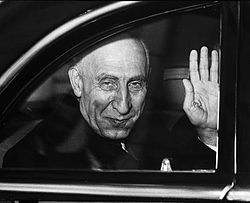
In March 1951 the Iranian Majlis and Senate voted to
nationalise Anglo-Iranian, which had controlled Iran's
oil industry since 1913 under terms disadvantageous to
Iran. Respected social reformer Dr Mohammad Mossadeq was
named prime minister the following month by a 79 to 12
majority. On 1 May Mossadeq carried out his government's
wishes, cancelling Anglo-Iranian’s oil concession
due to expire in 1993 and expropriating its assets.
His explanation, given in a speech in June 1951 (M. Fateh,
Panjah Sal-e Naft-e Iran, p. 525), ran as follows...
Our long years of negotiations with foreign countries… have yielded no results this far. With the oil revenues we could meet our entire budget and combat poverty, disease, and backwardness among our people. Another important consideration is that by the elimination of the power of the British company, we would also eliminate corruption and intrigue, by means of which the internal affairs of our country have been influenced. Once this tutelage has ceased, Iran will have achieved its economic and political independence.
The Iranian state prefers to take over the production of petroleum itself. The company should do nothing else but return its property to the rightful owners. The nationalization law provides that 25 per cent of the net profits on oil be set aside to meet all the legitimate claims of the company for compensation…
It has been asserted abroad that Iran intends to expel the foreign oil experts from the country and then shut down oil installations. Not only is this allegation absurd; it is utter invention…
For this he was eventually removed in a coup by MI5 and
the CIA, imprisoned for 3 years then put under house
arrest until his death.
In the meantime Britain orchestrated a world-wide boycott
of Iranian oil, froze Iran’s stirling assets and
threatened legal action against anyone purchasing oil
produced in the formerly British-controlled refineries.
It even considered invading. The Iranian economy was soon
in ruins. Attempts by the Shah to replace Mossadeq failed
and he returned with more power, but his coalition was
slowly crumbling under the hardships imposed by the
British blockade.
At first America was reluctant to join Britain’s
destructive game but Churchill let it be known that
Mossadeq was turning communist and pushing Iran into
Russia's arms at a time when Cold War jumpiness was high.
It was enough to get America's new president, Eisenhower,
on board and plotting with Britain to bring Mossadeq down
Chief of the CIA's Near East and Africa division, Kermit
Roosevelt Jr, arrived to play the leading role in an ugly
game of provocation, mayhem and deception. An elaborate
campaign of disinformation began, and the Shah signed two
decrees, one dismissing Mossadeq and the other nominating
the CIA's choice, General Fazlollah Zahedi, as prime
minister. These decrees were written as dictated by
Donald Wilbur the CIA architect of the plan
The Shah fled to Rome. When it was judged safe to do so
he returned on 22 August 1953. Mossadeq was arrested,
tried, convicted of treason by the Shah's military court
and sentenced to death.
Mossadeq remarked http://www.mohammadmossadegh.com/biography/
…
My greatest sin is that I nationalised Iran’s oil industry and discarded the system of political and economic exploitation by the world’s greatest empire… With God’s blessing and the will of the people, I fought this savage and dreadful system of international espionage and colonialism.
I am well aware that my fate must serve as an example in the future throughout the Middle East in breaking the chains of slavery and servitude to colonial interests.
The sentence was later commuted to three years' solitary
in a military prison, followed by house arrest until he
died on 5 March 1967. Mossadeq's supporters were rounded
up, imprisoned, tortured or executed.
Zahedi's new government soon reached an agreement with
foreign oil companies to form a consortium to restore the
flow of Iranian oil, awarding the US and Great Britain
the lion's share - 40 per cent going to Anglo-Iranian.
The consortium agreed to share profits on a 50-50 basis
with Iran but, tricky as ever, refused to open its books
for inspection or verification by Iranian auditors or
allow Iranians to sit on the board.
Anglo-Iranian changed its name to British Petroleum in
1954.
A grateful US massively funded the Shah's government,
including his army and secret police force, SAVAK.
The West's fun came to an abrupt halt with the Islamic
Revolution of 1979 and the book closed on a chapter in
British enterprise that started heroically, turned nasty
and ended in tears.
The US is still hated today for reinstating the Shah and
his vicious SAVAK, and for demolishing the Iranians’
democratic system of government, which the Revolution
unfortunately didn’t restore. Britain, as the
instigator and junior partner in the sordid affair, is
similarly despised.
On top of that, Iraq harbours great resentment at the way
the West, especially the US, helped Iraq develop its
chemical weapons arsenal and armed forces, and how the
international community failed to punish Iraq for its use
of chemical weapons against Iran in the Iran-Iraq war.
The US, and eventually Britain, tilted strongly towards
Saddam in that conflict and the alliance enabled Saddam
to more easily acquire or develop forbidden chemical and
biological weapons. At least 100,000 Iranians fell victim
to them.
This is how John King, writing in 2003 http://www.iranchamber.com/history/articles/arming_iraq.php
, summed it up…
The United States used methods both legal and illegal to help build Saddam's army into the most powerful army in the Mideast outside of Israel. The US supplied chemical and biological agents and technology to Iraq when it knew Iraq was using chemical weapons against the Iranians. The US supplied the materials and technology for these weapons of mass destruction to Iraq at a time when it was know that Saddam was using this technology to kill his Kurdish citizens. The United States supplied intelligence and battle planning information to Iraq when those battle plans included the use of cyanide, mustard gas and nerve agents. The United States blocked UN censure of Iraq's use of chemical weapons. The United States did not act alone in this effort. The Soviet Union was the largest weapons supplier, but England, France and Germany were also involved in the shipment of arms and technology.
Which brings us to today… Why are we hearing non-stop,
loud-mouthed sabre-rattling against Iran when we should
be extending the hand of friendship and reconciliation?
David Cameron (b. 1966) wasn’t even a twinkle in his
father’s eye when Britain crushed Iran’s
democracy, and was probably carousing with his Bullingdon
Club pals at Oxford while Iranians were dying in their
thousands from Saddam’s poison gases. What does he
know?
William Hague (b. 1961) seems similarly oblivious to the
dirty tricks previous British foreign secretaries pulled
on Iran.
Obama (b. 1961)? He was a community organiser in Chicago
while the Iranians were being mustard-gassed by chemicals
his country supplied to Saddam. What does he know?
As for Mrs Clinton (b. 1947), she’s old enough to
know better.
So why are they demonising Iran instead of righting the
wrongs? Why not live and let live?
Because the political establishment is still smarting.
They are the new-generation imperialists, the political
spawn of those Dr Mossadeq and many others struggled
against. They haven’t learned from the past, and
they won’t lift their eyes to a better future.
It’s so depressing.
Stuart Littlewood is author of the book Radio Free Palestine, which tells the plight of the Palestinians under occupation.
ANOTHER
ACCOUNT
Issue: 1974
dated: 29 October 2005 Features
www.socialistworker.co.uk/
A long history of interference in Iran
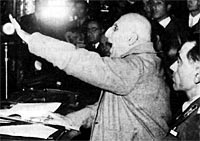
Mossadeq at his trial confronting his accusers
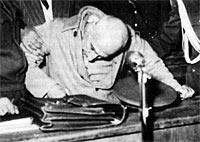
Mossadeq fainting from exhaustion
Recent threats against Iran follow a history of imperialist interference. John Newsinger looks at how Britain and the US conspired to topple a popular Iranian government in the 1950s
At a time when Tony Blair and his partners in crime are starting to prepare British public opinion for US bombing raids on Iran, it is worth remembering the last time a Labour government prepared for military action against Iran.
This was not New Labour, but Old Labour, in point of fact, the 1945-51 Attlee government.What provoked the government to prepare for military intervention was, incredible though it might seem, the Iranian decision to nationalise the country’s oil industry.Iran had been part of Britain’s informal empire since before the First World War. Although not occupied and ruled by the British in the way that India was, nevertheless Iranian governments accepted that they had to govern their country the way the British wanted. Failure to toe the line would provoke economic sanctions or intervention, either open or covert.
The discovery of oil at the beginning of the 20th century made the country all the more important to the British Empire. By the end of the Second World War, the Anglo-Iranian Oil Company (AIOC), today’s BP, was Britain’s largest overseas asset. In effect the AIOC ran the Iranian oil industry in the interests of British capitalism, with Iran’s interests not so much coming second as not running at all.
Profit
In 1950, for example, the AIOC made £200 million in profit, but paid the Iranians only £16 million in royalties, profit sharing and taxes.
It paid considerably more in taxes to the British government (£50 million) than it did to the Iranian government. Moreover this imperialist rip-off was the work of a company which was 51 percent owned by the British state.The Iranians’ sense of injustice was compounded by the fact that their oil cost more at home than it did in Britain. And, of course, British officials, businessmen and the like behaved with the same racist arrogance as they did throughout the British Empire.
At the end of April 1951 popular pressure forced the Shah, the British-backed ruler of Iran, to appoint a nationalist government with Mohammed Mossadeq as prime minister. On 1 May 1951 he announced the nationalisation of the oil industry.
The Labour government responded with outrage. As Emanuel Shinwell, the minister of defence, warned, “If Persia was allowed to get away with it, Egypt and other Middle Eastern countries would be encouraged to try it on—the next thing might be an attempt to nationalise the Suez Canal.” The foreign secretary, Peter Mandelson’s grandfather, Herbert Morrison, was strongly in favour of sending the troops in to seize the oilfields and overthrow Mossadeq. He confessed to one official that he wished he “was Lord Palmerston”, longing for the days when a gunboat could be sent to intimidate the “natives”.Like Shinwell, he warned the cabinet that “failure to exhibit firmness in this matter may prejudice our interests throughout the Middle East”. There were not the troops available to seize the oilfields though.
The Attlee government had already committed British troops to fight alongside the US in Korea, there was a brutal colonial war underway in Malaya and thousands of British troops were confronting the Egyptians who wanted their Canal Zone military bases back.
Instead, it was decided to seize the Abadan oil refinery in the appropriately named Operation Buccaneer. Hopefully this would bring about Mossadeq’s downfall.What stopped this imperial adventure? Remarkably enough it was US opposition. The US was intent on undermining the British position throughout the Middle East and made clear that it would not support military action against Iran.Attlee summed up the cabinet discussion, concluding that it was “the general view of the cabinet that, in the light of the United States’ attitude… force could not be used to hold the refinery… We could not afford to break with the United States on an issue of this kind.”
Once Labour lost power, Churchill’s Tory government cooperated with the US in covert action to overthrow Mossadeq. Sanctions, introduced by Labour, had wrecked the Iranian economy and in August 1953 a CIA financed and organised coup (MI6 was a junior partner) was staged. Mossadeq was overthrown and the Shah was installed as an absolute monarch, ruling through imprisonment, torture, execution and fear. There were no complaints about his regime’s methods from either the British or US governments. The Iranian oil industry was placed in the hands of an international consortium in which the British found themselves with a much reduced 40 percent share as the US pushed them aside.
The US was replacing Britain as the dominant power in the Middle East and British governments were reluctantly beginning to realise that they were now US imperialism’s junior partner.
John Newsinger's books include British Counterinsurgency: From Palestine to Northern Ireland